
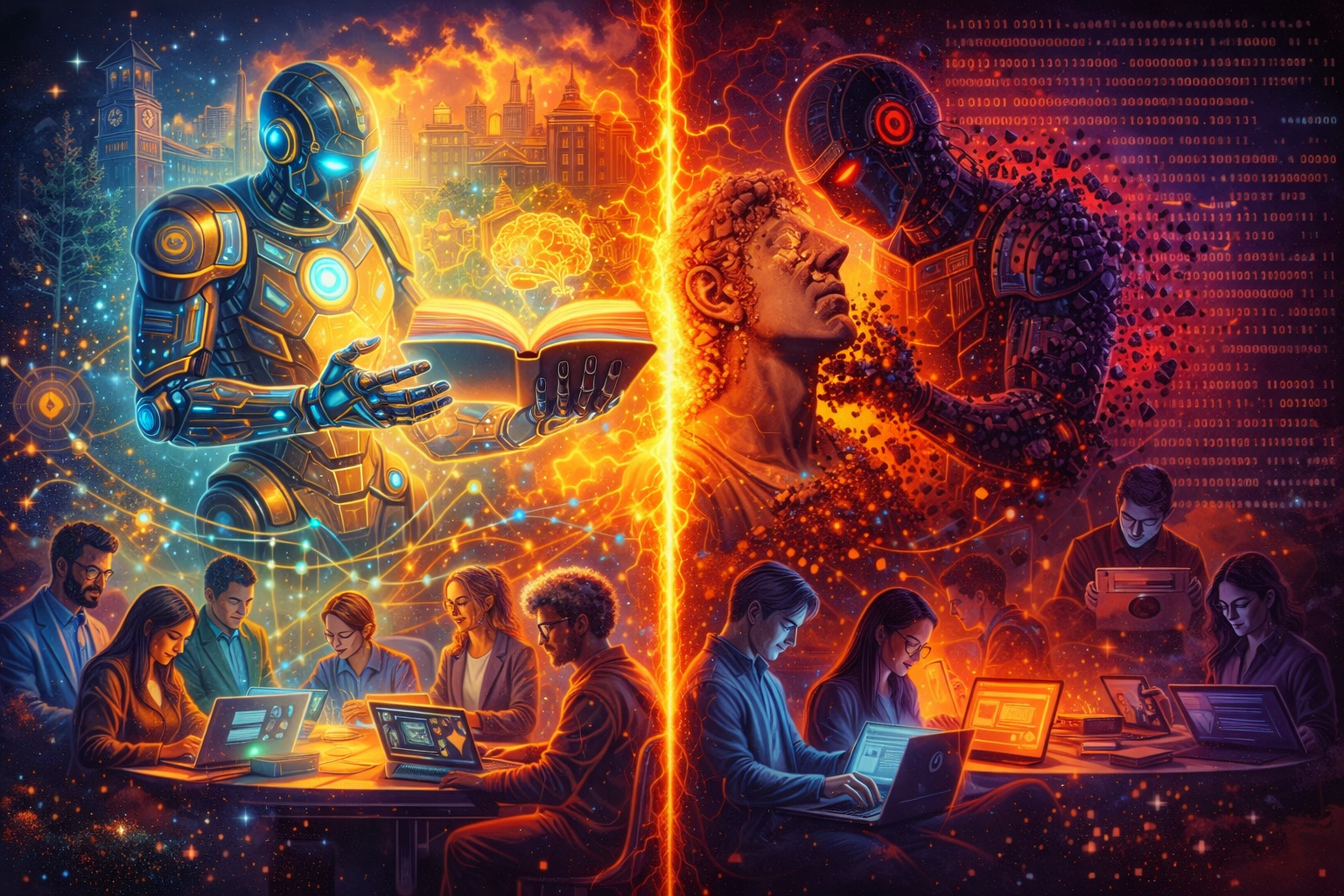
The Promise and Peril of Artificial Intelligence in Higher Education
By: James Lipuma & Cristo León
Blog post about the article by Lipuma and León (2025) published in the Journal of Systemics, Cybernetics and Informatics, last updated on December 19, 2025.
Introduction
Artificial Intelligence (AI) is reshaping higher education with unprecedented speed. While AI-enabled tools promise personalization, efficiency, and expanded access, they also introduce risks that challenge the core human purposes of education. This article examines AI not as a neutral technology, but as a socio-epistemic force that reconfigures how learning, teaching, and institutional decision-making occur.
The Promise of AI in Higher Education
Drawing on transdisciplinary communication (TDC) and educational psychology, the authors identify how AI can enhance collaboration, automate administrative burdens, support multilingual inclusion, and enable adaptive learning environments. When used intentionally, AI can function as a catalyst for transformative learning rather than a shortcut around it.
The Perils of Automation
The article cautions that uncritical reliance on AI risks eroding essential human capacities, including critical thinking, ethical reasoning, empathy, and intellectual independence. Over-automation can reduce reflective depth, turning learning into procedural compliance rather than inquiry-driven meaning-making.
What Remains Non-Delegable
The analysis identifies interpretation, judgment, and contextual understanding as fundamentally human dimensions that cannot be outsourced to AI systems. These capacities anchor education’s ethical and civic responsibilities and must remain central even as AI becomes more capable.
Implications for Institutions
Rather than framing AI as a replacement for cognition, the authors argue for a human-in-the-loop approach that foregrounds metacognition, reflexivity, and ethical discernment. Institutions must design policies, curricula, and assessment practices that ensure AI amplifies inquiry rather than undermines it.
Cite this Paper
Lipuma, J., & León, C. (2025). The Promise and Peril of Artificial Intelligence in Higher Education. Journal of Systemics, Cybernetics and Informatics, 23(7), 176–182. https://doi.org/10.54808/JSCI.23.07.176
DOI: 10.54808/JSCI.23.07.176
ISSN: 1690-4524
Volume: 23 | Issue: 7 | Pages: 176–182
Publisher: International Institute of Informatics and Cybernetics
License: Creative Commons Attribution–NonCommercial–ShareAlike 4.0 International
Keywords: artificial intelligence; higher education; ethics; metacognition; transdisciplinary communication; transformative learning
Interested in Exploring or Collaborating?
Are you working on AI, education, ethics, or institutional transformation? Share this post, or cite the article to advance responsible AI integration in higher education.
Copyright
© 2025 Lipuma & León. Published by the International Institute of Informatics and Cybernetics.
PDF download
Versión en Español
La Promesa y el Riesgo de la Inteligencia Artificial en la Educación Superior
Entrada de blog sobre el artículo de Lipuma y León (2025) publicado en el Journal of Systemics, Cybernetics and Informatics.
Introducción
La inteligencia artificial está transformando la educación superior con gran rapidez. Este artículo analiza tanto su potencial transformador como los riesgos asociados a la automatización excesiva, destacando la necesidad de preservar el pensamiento crítico, la reflexión ética y la autonomía intelectual.
Aporte Central
Desde la comunicación transdisciplinaria y la psicología educativa, se argumenta que la IA debe entenderse como un catalizador del aprendizaje transformador y no como un sustituto de la cognición humana. La reflexión metacognitiva y el enfoque humano-en-el-bucle son esenciales para una integración ética e inteligente.