
• Skip to main navigation
  • Skip to main content
  • Skip to footer
Cristo León

Cristo León

Digital Mentoring

  • Actividades
    • Innovación Ejecutiva
    • Mentoría
      • Guía del Proceso de Planeación Estratégica CLDM
    • Nuestros Clientes
      • Testimonios de clientes
      • Testimonios de socios
  • Recursos
    • Publicaciones
    • Blog
    • Noticias
  • CLDM
    • Nosotros
      • Misión
      • Sobre CLDM
      • Currículum
      • Nuestro equipo
    • Lenapehoking
    • Socios Clave
    • Legal
      • Aviso de Privacidad Integral
      • Terminos y Condiciones
      • Códigos de Ética
  • Skip to menu toggle button
  • Facebook
  • Twitter
  • LinkedIn
  • Back to top ↑

Header Widgets

Project Category: 1. SCIENCE AND ENGINEERING FIELDS

A. COMPUTER AND INFORMATION SERVICES 1442
B. ENGINEERING
(1) Aerospace, Aeronautical, and Astronautical 1411
(2) Bioengineering & Biomedical Engineering 1418
(3) Chemical Engineering 1412
(4) Civil Engineering 1413
(5) Electrical, Electronic, and Communications 1414
(6) Industrial and Manufacturing Engineering 1419
(7) Mechanical Engineering 1415
(8) Metallurgical & Materials Engineering 1417
(9) Other Engineering 1416
C. GEOSCIENCES, ATMOSPHERIC SCIENCES & OCEAN SCIENCES
(1) Atmospheric Science & Meteorology 1431
(2) Geological and Earth Sciences 1432
(3) Ocean Sciences and Marine Sciences 1433
(4) Other 1434
D. LIFE SCIENCES
(1) Agricultural Sciences 1451
(2) Biological and Biomedical Sciences 1452
(3) Health Sciences 1453
(4) Natural Resources and Conservation 1455
(5) Other Life Sciences 1454
E. MATHEMATICS AND STATISTICS 1441
F. PHYSICAL SCIENCES
(1) Astronomy and Astrophysics 1421
(2) Chemistry 1422
(3) Materials Science 1425
(4) Physics 1423
(4) Other Physical Sciences 1424
G. PSYCHOLOGY 1460

H. SOCIAL SCIENCES
(1) Anthropology 1475
(2) Economics 1471
(3) Political Science and Government 1472
(4) Sociology, Demography, and Population Studies 1473
(5) Other Social Sciences 1474
I. OTHER SCIENCES, not elsewhere classified 1480

Polyvocal Semantic Infrastructure for TTRPG Research | Multimedia Play Data

Project Category: 1480 – Other Sciences: RPGT (Role-Playing Game Theory), 1480 – Other Sciences: TTRPGs, S&E I. OTHER SCIENCES
Project Tag: knowledge organization, Multimedia Play Data, multimodal analysis, Polyvocal Semantic Infrastructure, provenance-aware AI, semantic interoperability, TTRPG research
Tabla comparativa de las funciones del Dungeon Master en Dungeons & Dragons entre 1974 y 2024, incluyendo arbitrar reglas, crear mundos, enseñar, improvisar y narrar.

El Mentor del Juego: Mediador Intercultural en las Mesas de Juegos de Rol

Project Category: 1480 – Other Sciences: Game Studies, 1480 – Other Sciences: RPGT (Role-Playing Game Theory), 1480 – Other Sciences: TTRPGs, Non S&E A. EDUCATION, Non S&E C. HUMANITIES
An allegorical illustration of a woman depicted as a cyborg Tank character, blending human features with armored, technological elements. She stands at the center of a digital battlefield, illuminated and highly visible, while data streams and social symbols surround her, representing scrutiny, emotion, and performance.

Playing by Feel

Project Category: 1480 – Other Sciences: Game Studies
Project Tag: cyborg identity, emotion, feminist game studies, Gender, playstyles, role choice, transdisciplinary communication (TDC)
A colorful allegorical illustration showing the CREL Framework, with the five components—Scenario, Social Contract, Collaboration, Choice, and Experience—represented as interconnected glowing nodes surrounding a group engaged in role-playing at a central table.

How Does the CREL Framework Facilitate Effective Interdisciplinary Collaboration and Experiential Learning Through Role-Playing?
Project Category: 1480 – Other Sciences: RPGT (Role-Playing Game Theory), 1530 - Storytelling, 1530 – IDR (Inter-Disciplinary Research), 1560 - IDC (Inter-Disciplinary Communication), S&E I. OTHER SCIENCES
Project Tag: Ludology, Power Dynamics, Reflectivity, Scenario Design, Social Contract, Transdisciplinarity, Transformative Learning
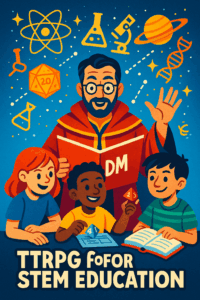
A colorful illustration showing a Dungeon Master in a wizard’s robe guiding three children around a tabletop filled with books and dice. Around them float scientific symbols like atoms, microscopes, DNA strands, and planets, symbolizing the link between imagination and STEM learning.

Examining the Expertise of TTRPG for STEM Education

Project Category: 1480 – Other Sciences: RPGT (Role-Playing Game Theory), 1510 - STEAM EDUCATION, Non S&E A. EDUCATION
Project Tag: Collaborative Learning, Experiential Learning (EL), Facilitation Competencies, Game-Based Pedagogy, Inquiry-Based Learning (IBL), Mixed-Methods Research (MMR), RPG, TTRPG
Allegorical illustration showing three overlapping magnifying lenses labeled “What RPGs Are Not,” “Essential Elements,” and “The Meta of RPGs,” placed over layered parchment pages with dice, books, symbols, and cosmic imagery.

A Tri-Heuristic Ontological Approximation of Tabletop RPGs

Project Category: 1480 – Other Sciences: RPGT (Role-Playing Game Theory)

Project Tag: essential elements, game studies, heuristics, metaphors, ontology, RPG theory
An expansive cityscape depicting a future where advanced technology and AI are integrated into daily life, with holographic displays, robots interacting with humans, and sleek, modern architecture.

A Brave New World: AI as a Nascent Regime?

Project Category: 1472 – Political Science and Government, S&E H. SOCIAL SCIENCES
Project Tag: Artículos de Revista Académica
A circular word cloud displaying the most frequent terms from Shared Fantasy by Gary Alan Fine, with “games,” “fantasy,” “campaign,” “players,” “new,” and “first” appearing largest, surrounded by related terms such as “kuhn,” “break,” “preface,” “war,” and “gaming.”

Shared Fantasy: Role-Playing Games as Social Worlds by Gary Alan Fine (2002) – Reseña

Project Category: 1480 – Other Sciences: Game Studies, 1480 – Other Sciences: TTRPGs, S&E I. OTHER SCIENCES
Project Tag: Artículos de Revista Académica

Innovación Disruptiva y Sostenibilidad, Recurso

Project Category: 1472 – Political Science and Government
Project Tag: Documentos

Buscar en el sitio

Post recientes

04 Nov

Accessibility for Faculty and Staff with Visual Impairments

Accessibility in higher education extends beyond student services and legal compliance. This essay examines how U.S. public universities support faculty and professional staff with visual impairments, identifying the technological, administrative, and organizational conditions that influence equitable participation in academic work. It proposes a conceptual distinction between formal accessibility, functional accessibility, and institutional inclusion as a foundation for further literature review.
Continue reading “Accessibility for Faculty and Staff with Visual Impairments”…
03 Nov

Juegos de rol: metodología para evaluar competencias

Por el Dr. Cristo León.Última revisión 3 de noviembre de 2026. Del entretenimiento a la investigación del comportamiento humano Durante décadas, los juegos de rol han permitido que las personas exploren mundos imaginarios, interpreten personajes y enfrenten situaciones que requieren…
Continue reading “Juegos de rol: metodología para evaluar competencias”…
02 Nov

Ritmo en los juegos de rol: temporalidad, agencia y experiencia

El ritmo en los juegos de rol no depende solo de la velocidad o del pacing. Surge de la interacción entre temporalidad, agencia, contingencia, resistencia, focalización y experiencia subjetiva.
Continue reading “Ritmo en los juegos de rol: temporalidad, agencia y experiencia”…
30 Oct

Pensar el ritmo del cómic: tiempo, espacio y performance de lectura

¿Dónde se encuentra realmente el ritmo de un cómic? Este ensayo explora la relación entre viñetas, canaletas, secuencia, página y actividad del lector para proponer una distinción preliminar entre ritmo diseñado y ritmo experimentado. A partir de Gallego Escobar (2016), se plantean preguntas y posibles líneas de investigación previas a una revisión formal de literatura.
Continue reading “Pensar el ritmo del cómic: tiempo, espacio y performance de lectura”…

Categorías del blog

Análisis Aprendizaje experiencial Business Storytelling Capítulos de libro Certificados Co-diseño Colaboración Comunicación Comunicación efectiva Concepción Conflicto Constancia Convergencia Definiciones Desarrollo Educación Efectivo English Ensayo Estrategia Frases Habilidades interculturales House of Leaves — Notas del Semionauta Infografía Innovación Investigación Keynote Liderazgo transformacional Marketing Marketing Digital Marketing holístico Mentoría Microrelato Narrativa Negociación Planeación estratégica Ponencia Resolución de Problemas Resumen Ritmo en los juegos de rol Roleplaying Games (RPG) Sin categoría STEAM STEM Teoría de juegos

Categorías de recursos

1. SCIENCE AND ENGINEERING FIELDS 2. NON-SCIENCE AND ENGINEERING FIELDS 1472 – Political Science and Government 1480 – Other Sciences: Game Studies 1480 – Other Sciences: RPGT (Role-Playing Game Theory) 1480 – Other Sciences: TTRPGs 1510 - Digital and Hybrid Learning Environments 1510 - EEA (Educational Evaluation and Assessment) 1510 - STEAM EDUCATION 1510 – CID (Curriculum Instructional Design) 1530 - Storytelling 1530 - TDR (Trans-Disciplinary Research) 1530 – IDR (Inter-Disciplinary Research) 1550 - Digital marketing 1550 - Organizational leadership 1550 - R&D (Research and Development) 1560 - IDC (Inter-Disciplinary Communication) 1560 - Strategic research communication 1560 – TDC (Trans-Disciplinary Communication) 1580 - Broadening Participation in STEM Non S&E A. EDUCATION Non S&E C. HUMANITIES Non S&E E. BUSINESS MANAGEMENT AND BUSINESS ADMINISTRATION Non S&E F. COMMUNICATIONS, COMMUNICATIONS TECHNOLOGIES, JOURNALISM Non S&E I. OTHER NON-S&E FIELDS S&E H. SOCIAL SCIENCES S&E I. OTHER SCIENCES
  • Aviso de Privacidad Integral
  • Códigos de Ética

Frase del día

La Visión es ver hacia dónde vas, la Mision es planear cómo llegarás allí. Esta es la diferencia entre las dimensiones aspiracionales y las operativas. Cristo León

Preguntas

¿Tienes una duda, comentario o propuesta de colaboración?

Envíame tu pregunta y con gusto te responderé personalmente.

Al hacer clic en Formulario de preguntas serás redirigido al formulario oficial de CLDM. Tus datos se usarán exclusivamente para responder tu mensaje.

Sobre nosotros

Empoderando la Co-creación Colaborativa mediante investigación accesible, narrativas lúdicas y entornos de aprendizaje que despierten la curiosidad, fomenten la innovación y amplíen la participación social.

CLDM es una empresa de mentoría digital e innovacion ejecutiva fundada en 2010.

Posts recientes

04 Nov

Accessibility for Faculty and Staff with Visual Impairments

Accessibility in higher education extends beyond student services and legal compliance. This essay examines how U.S. public universities support faculty and professional staff with visual impairments, identifying the technological, administrative, and organizational conditions that influence equitable participation in academic work. It proposes a conceptual distinction between formal accessibility, functional accessibility, and institutional inclusion as a foundation for further literature review.
Continue reading “Accessibility for Faculty and Staff with Visual Impairments”…
03 Nov

Juegos de rol: metodología para evaluar competencias

Por el Dr. Cristo León.Última revisión 3 de noviembre de 2026. Del entretenimiento a la investigación del comportamiento humano Durante décadas, los juegos de rol han permitido que las personas exploren mundos imaginarios, interpreten personajes y enfrenten situaciones que requieren…
Continue reading “Juegos de rol: metodología para evaluar competencias”…
02 Nov

Ritmo en los juegos de rol: temporalidad, agencia y experiencia

El ritmo en los juegos de rol no depende solo de la velocidad o del pacing. Surge de la interacción entre temporalidad, agencia, contingencia, resistencia, focalización y experiencia subjetiva.
Continue reading “Ritmo en los juegos de rol: temporalidad, agencia y experiencia”…

RSS CLDM RSS

  • Accessibility for Faculty and Staff with Visual Impairments
    Accessibility in higher education extends beyond student services and legal compliance. This essay examines how U.S. public universities support faculty and professional staff with visual impairments, identifying the technological, administrative, and organizational conditions that influence equitable participation in academic work. It proposes a conceptual distinction between formal accessibility, functional accessibility, and institutional inclusion as a […]

RSS NSF Funding opportunities RSS

  • Major Research Instrumentation Program (MRI)
  • NSF Graduate Research Fellowship Program (GRFP)
  • Expeditions in Computing (Expeditions)
  • Facebook
  • Twitter
  • LinkedIn
  • Back to top ↑
© 2010-2026 CL Digital Mentoring | Creative Commons CC BY-NC-ND | Atribución-NoComercial-SinDerivadas