
From Disciplinary Silos to Cyber-Transdisciplinary Networks: A Plural Epistemic Model for AGI-Era Knowledge Production
By: Cristo León & James Lipuma
Blog post about the article by León and Lipuma (2025) published in the Journal of Systemics, Cybernetics and Informatics, last updated on December 19, 2025.
Introduction
This article extends a keynote delivered at the 16th International Multi-Conference on Information and Cybernetics (IMCIC 2025) and addresses a central challenge facing higher education and research institutions: how to govern knowledge production in the era of Artificial General Intelligence (AGI). The paper argues that disciplinary, interdisciplinary, and even transdisciplinary approaches are increasingly insufficient to manage epistemic plurality, speed, and scale under AGI-mediated conditions.
Conceptual Framework
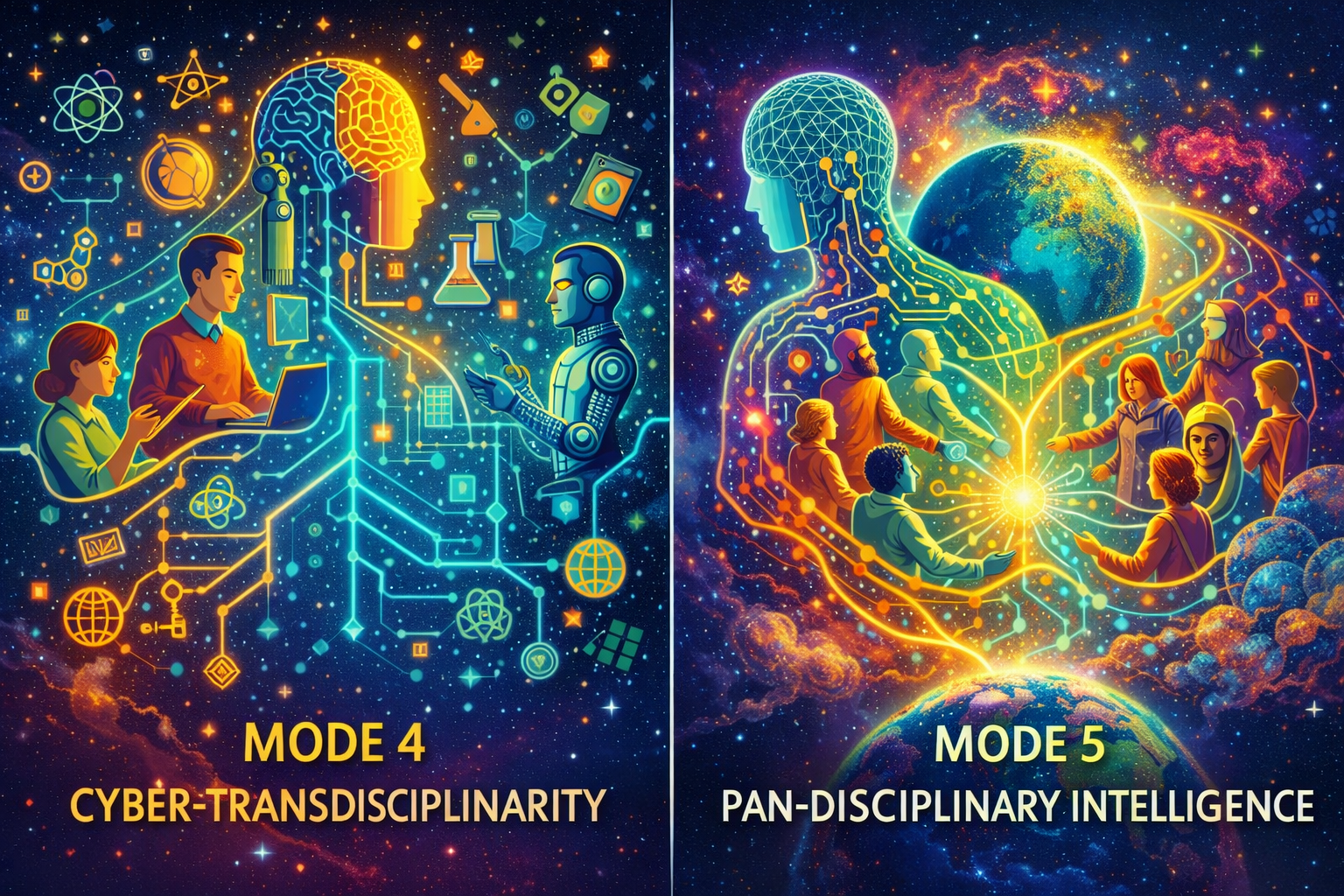
Drawing on critical communication and knowledge theories, the article synthesizes insights from incommensurability theory, invention and différend, commons governance, and situated knowledge to propose a new epistemic mode. Mode 4—cyber-transdisciplinarity—conceptualizes AGI not as a neutral tool, but as an epistemic co-agent capable of mediating, synthesizing, and redistributing knowledge in real time across human and machinic actors.
Methodological Orientation
Methodologically, the article advances a plural foundation that integrates constructivist grounded theory, antenarrative inquiry, and intercultural competence. These approaches support reflexive sensemaking in environments where knowledge is provisional, contested, and dynamically reconfigured by algorithmic systems.
Illustrative Case
An institutional case study featuring a cybernetic governance dashboard demonstrates how adaptive infrastructures can support reflexive decision-making. The dashboard exemplifies how institutions can align ethical stewardship, epistemic diversity, and AGI-enabled intelligence within evolving knowledge ecosystems.
Implications and Future Directions
The article concludes by anticipating a speculative Mode 5—pan-disciplinary intelligence—characterized by AGI-facilitated, planetary-scale knowledge integration. It argues that cyber-transdisciplinary competence is not optional, but essential for institutions seeking to adapt responsibly to AGI’s transformative impact on governance, research, and transdisciplinary communication.
Cite this Paper
León, C., & Lipuma, J. (2025). From Disciplinary Silos to Cyber-Transdisciplinary Networks: A Plural Epistemic Model for AGI-Era Knowledge Production.
Journal of Systemics, Cybernetics and Informatics, 23(7), 102–115.
https://doi.org/10.54808/JSCI.23.07.102
DOI: 10.54808/JSCI.23.07.102
ISSN: 1690-4524
Volume: 23 | Issue: 7 | Pages: 102–115
Publisher: International Institute of Informatics and Cybernetics (IIIC)
Rights: © 2003–2025 IIIC. All rights reserved.
Keywords: AGI; epistemic pluralism; cyber-transdisciplinarity; governance; antenarrative; intercultural competence; knowledge ecosystems
Interested in Exploring or Collaborating?
Are you working on AGI, knowledge governance, or transdisciplinary communication?
Share this post, or cite the article to advance dialogue on cyber-transdisciplinary futures.
Versión en Español
De Silos Disciplinares a Redes Ciber-Transdisciplinarias: Un Modelo Epistémico Plural para la Producción de Conocimiento en la Era de la AGI
Entrada de blog sobre el artículo de León y Lipuma (2025) publicado en el Journal of Systemics, Cybernetics and Informatics.
Introducción
Este artículo amplía una conferencia magistral presentada en IMCIC 2025 y examina los desafíos epistémicos que enfrentan las instituciones académicas ante la emergencia de la inteligencia artificial general (AGI). Se sostiene que los enfoques disciplinares, interdisciplinares y transdisciplinares ya no son suficientes para gestionar la complejidad, pluralidad y velocidad del conocimiento en la era algorítmica.
Aporte Central
El texto propone el Modo 4—ciber-transdisciplinariedad—como un marco que reconoce a la AGI como co-agente epistémico. Este enfoque permite la mediación, síntesis y redistribución del conocimiento entre actores humanos y maquínicos, bajo principios de gobernanza reflexiva y ética.
Cita el artículo
León, C., & Lipuma, J. (2025). De Silos Disciplinares a Redes Ciber-Transdisciplinarias: Un Modelo Epistémico Plural para la Producción de Conocimiento en la Era de la AGI.
Journal of Systemics, Cybernetics and Informatics, 23(7), 102–115.
https://doi.org/10.54808/JSCI.23.07.102