
How Does the CREL Framework Facilitate Effective Interdisciplinary Collaboration and Experiential Learning Through Role-Playing?
By: James Lipuma & Cristo León
Blog post about the article by Lipuma and León (2025) published in the Journal of Systemics, Cybernetics and Informatics, last updated on December 19, 2025.
Introduction
Interdisciplinary collaboration in higher education frequently struggles to move beyond symbolic integration, resulting in fragmented communication and shallow collaboration. This article examines how the Components of Role-playing in Experiential Learning (CREL) Framework addresses these challenges by embedding role-playing as a structured epistemic practice rather than a supplementary activity.
The CREL Framework
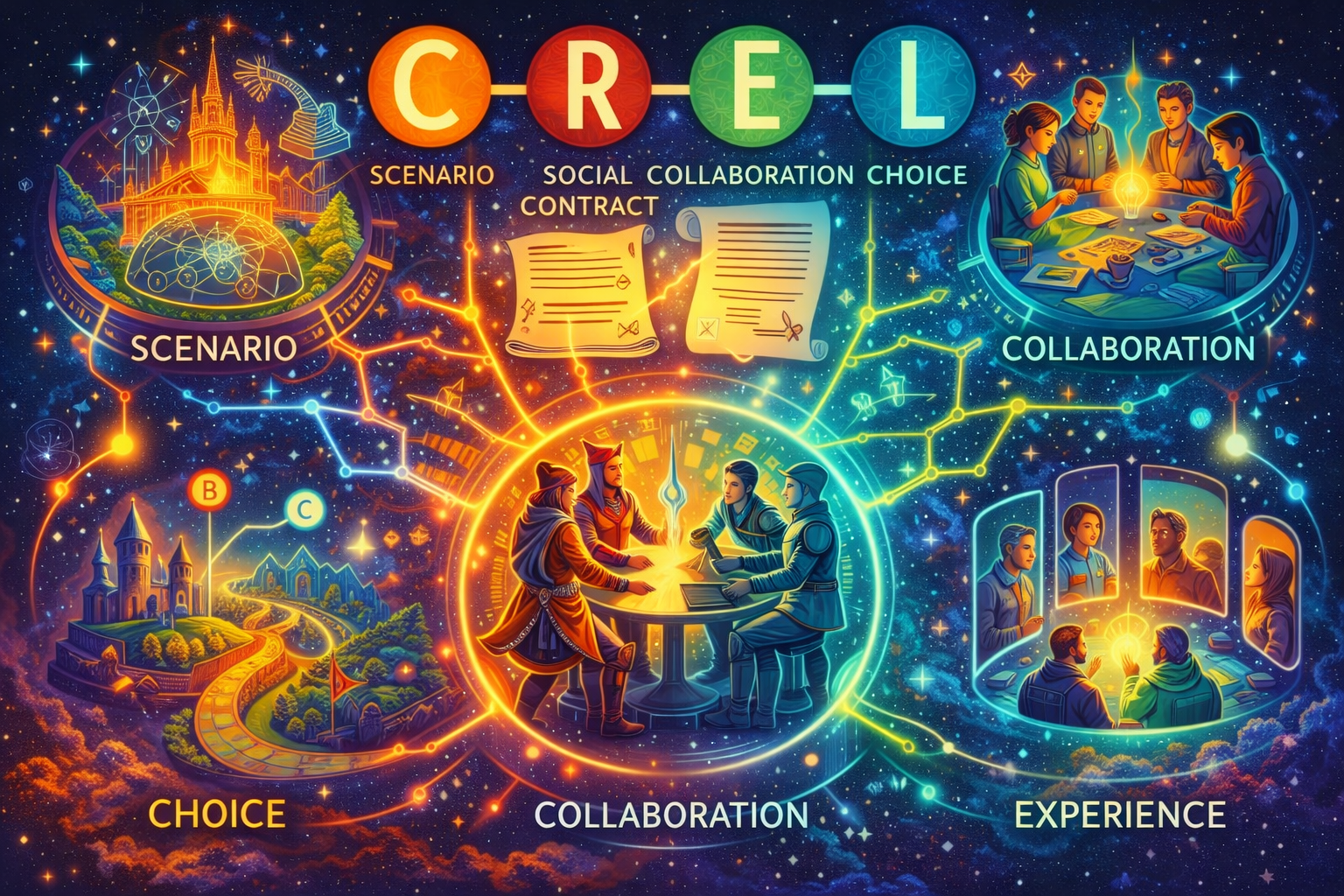
The article introduces the five core components of the CREL Framework—Scenario, Social Contract, Collaboration, Choice, and Experience—and explains how they function as an integrated system for designing, facilitating, and assessing interdisciplinary learning environments. Together, these components create conditions for participants to inhabit perspectives beyond their disciplinary identities.
Role-Playing as Epistemic Practice
Drawing from ludology, experiential education, and transdisciplinary communication theory, the authors argue that CREL catalyzes authentic collaboration by simulating complex, real-world scenarios that require adaptive thinking, dialogic engagement, and co-constructed solutions. Role-playing is positioned not as a pedagogical gimmick, but as a legitimate mode of inquiry and knowledge production.
Implications for Interdisciplinary Education
By reframing play as a rigorous epistemic mechanism, the CREL Framework supports more inclusive, participatory, and reflective forms of interdisciplinary learning. The article addresses limitations, anticipates common critiques, and calls for curricular, institutional, and policy reforms to legitimize role-play as a scholarly and professional practice.
Cite this Paper
Lipuma, J., & León, C. (2025).
How Does the CREL Framework Facilitate Effective Interdisciplinary Collaboration and Experiential Learning Through Role-Playing?
Journal of Systemics, Cybernetics and Informatics, 23(7), 126–145.
https://doi.org/10.54808/JSCI.23.07.126
DOI: 10.54808/JSCI.23.07.126
ISSN: 1690-4524
Volume: 23 | Issue: 7 | Pages: 126–145
Publisher: International Institute of Informatics and Cybernetics (IIIC)
Rights: © 2003–2025 IIIC. All rights reserved.
Keywords:
CREL Framework; role-playing; experiential learning; interdisciplinary collaboration; transdisciplinary communication; scenario design; social contract
Interested in Exploring or Collaborating?
Are you working on interdisciplinary education, experiential learning, or role-playing methodologies?
Share this post, or cite the article to advance scholarship on role-play as an epistemic practice.
Copyright
© 2025 Lipuma & León. Published by the International Institute of Informatics and Cybernetics.
PDF Download
Versión en Español
¿Cómo Facilita el Marco CREL la Colaboración Interdisciplinaria Efectiva y el Aprendizaje Experiencial Mediante el Juego de Rol?
Entrada de blog sobre el artículo de Lipuma y León (2025) publicado en el
Journal of Systemics, Cybernetics and Informatics.
Introducción
La colaboración interdisciplinaria en la educación superior suele quedarse en integraciones superficiales. Este artículo analiza cómo el marco CREL propone una alternativa al integrar el juego de rol como una práctica epistémica estructurada que permite la adopción de perspectivas, la reflexión crítica y la co-construcción de conocimiento.
Aporte Principal
El marco CREL articula cinco componentes clave—Escenario, Contrato Social, Colaboración, Elección y Experiencia—que, en conjunto, facilitan aprendizajes auténticos y transformadores. El juego se presenta como un mecanismo riguroso para el aprendizaje experiencial y la comunicación transdisciplinaria.