
By Cristo Leon, Ph.D.
Last reviewed 04/09/2026.
introduction
In many organizational conversations, the terms strategy, strategic formulation, and strategic planning are treated as if they were interchangeable. They are not. Collapsing them into a single category creates conceptual confusion and weakens both leadership decisions and implementation. Each term refers to a different level of organizational work. Distinguishing them improves analytical clarity and practical execution.
Why the distinction matters
Organizations often say they need a “strategic plan” when, in fact, they have not yet clarified their strategy. Others begin planning before leadership has made the decisions that planning is supposed to organize. In both cases, the result is predictable: a document may be produced, but direction remains unclear.
The problem is not simply terminological. It is structural. These concepts correspond to different questions, different responsibilities, and different moments in the organizational process.
1. Strategy: what the organization will do and why
At the highest level, strategy defines the organization’s directional logic. It answers the question: How will we win?
This is the level at which the organization clarifies what it seeks to achieve, where it will focus, what position it will take, and why that direction is expected to produce success. Strategy is not a list of activities. It is not a calendar. It is not a set of isolated goals. It is the coherent rationale that explains the organization’s chosen path.
A useful way to think about strategy is this: it establishes the organization’s theory of advantage. It identifies the basis on which the organization believes it can succeed relative to its environment, competitors, constraints, or mission.
Without this clarity, everything that follows becomes unstable.
2. Strategic formulation: how leaders decide what the organization will do
If strategy is the content of direction, strategic formulation is the process through which that direction is defined.
This is the stage where leaders interpret internal and external conditions, identify opportunities and threats, weigh alternatives, and decide what the organization will pursue. Strategic formulation is therefore not the same as strategy itself. Rather, it is the decision-making process that produces strategy.
This distinction matters because many organizations confuse decision-making with planning. They gather teams, discuss possibilities, generate ideas, and call the exercise “planning,” when in reality they are still in the formulation stage. They have not yet determined the strategic direction. They are still deciding it.
Strategic formulation asks questions such as:
- What are the conditions shaping our choices?
- What priorities should guide the organization?
- What tradeoffs are necessary?
- What course of action should leadership commit to?
Until these questions are answered, planning remains premature.
3. Strategic planning: how strategic decisions are organized for implementation
Once the strategy is clear and leadership decisions have been made, strategic planning can begin.
Strategic planning does not decide the organization’s direction. It translates that direction into an implementable structure. This is the stage where strategic decisions are organized into objectives, initiatives, timelines, responsibilities, metrics, and resource commitments.
In other words, strategic planning operationalizes what has already been decided.
This is why planning should be understood as a downstream activity. It depends on prior clarity. If the organization does not know how it intends to win, or if leadership has not yet decided what course of action it wants to pursue, planning cannot do its job. At best, it produces administrative order without strategic coherence. At worst, it gives the illusion of progress while masking unresolved decisions.
A simple sequence
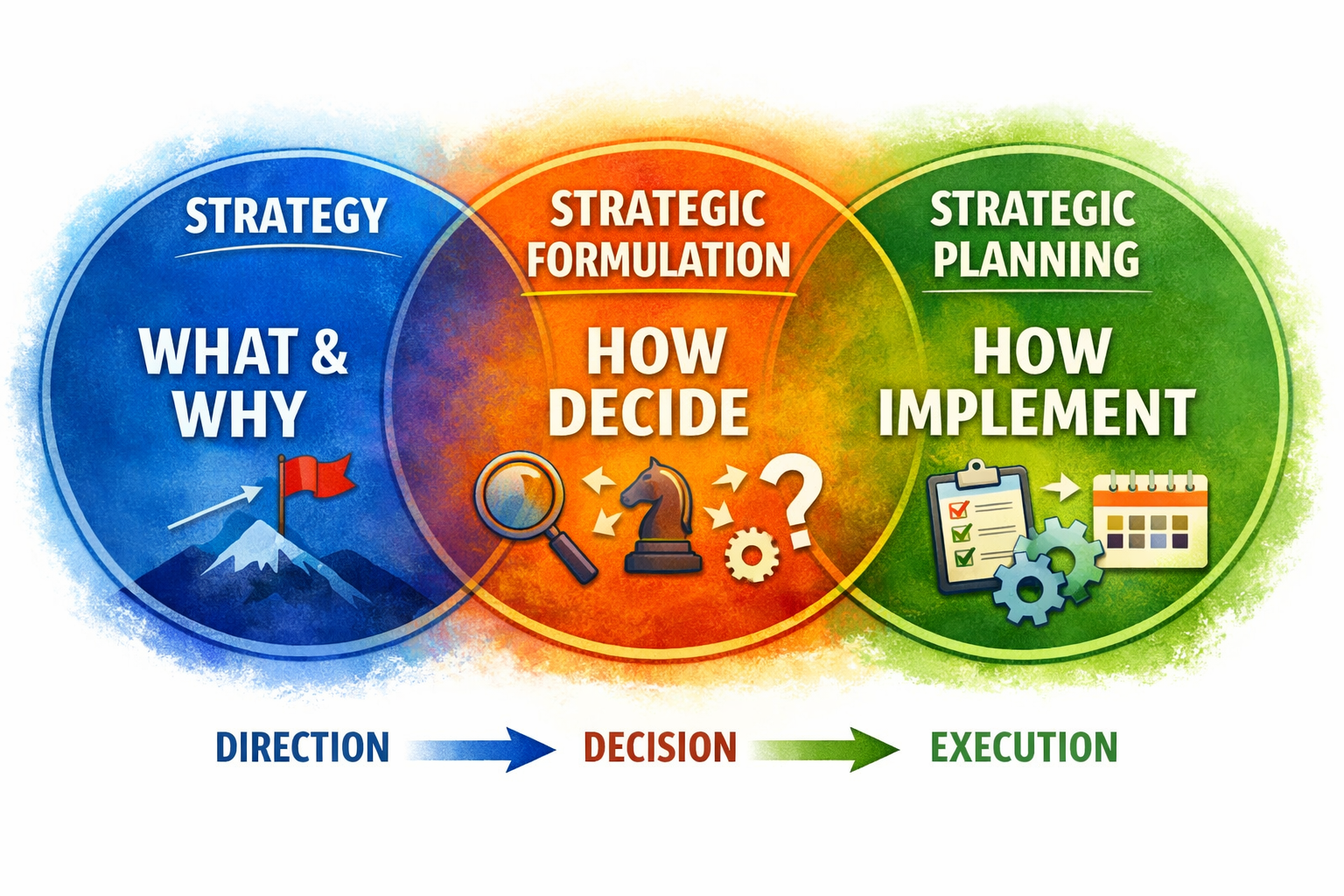
The relationship among the three concepts can be stated clearly:
Strategy asks: What will the organization do, and why?
Strategic formulation asks: How do leaders decide that?
Strategic planning asks: How are those decisions organized for implementation?
This sequence is not trivial. It marks a progression from direction to decision to execution.
The “entry door” to planning
A useful practical insight follows from this distinction: strategic planning should begin only when two conditions are present.
First, the organization must have a sufficiently clear understanding of its strategy. It must know, at least in broad terms, what it intends to do and why.
Second, leadership must have made the core decisions that define that direction. Whether the leader is an individual executive, a leadership team, or a governing body, planning requires a prior decision framework.
Only when those conditions are met does planning become meaningful. At that point, the organization can sit down and ask the right question: How will these decisions be implemented?
This is the true entry point of strategic planning.
What happens when organizations confuse the stages
When the three concepts are blurred, several recurring problems appear.
First, organizations may produce plans without a strategy. In this case, activities are listed, deadlines are assigned, and responsibilities are distributed, but the underlying rationale remains weak or fragmented.
Second, leaders may remain stuck in formulation while believing they are planning. Meetings become long discussions about possibilities, but no actual strategic commitments are made.
Third, implementation teams may be asked to execute priorities that were never fully defined. This creates ambiguity, duplication, and frustration.
In each case, the root issue is the same: the organization failed to distinguish among directional logic, leadership decision-making, and operational translation.
A more precise organizational language
For practitioners, consultants, and scholars, the remedy is straightforward: use the terms with precision.
Do not call planning what is actually formulation.
Do not call a strategy what is merely a list of tasks.
Do not assume implementation can compensate for unresolved strategic choices.
A more accurate vocabulary strengthens both analysis and practice. It allows leaders to identify where they are in the process, what kind of work remains to be done, and which questions belong to which stage.
Final reflection
Strategy, strategic formulation, and strategic planning are related, but they are not equivalent. Strategy defines how the organization intends to win. Strategic formulation is the process through which leaders decide the direction. Strategic planning organizes those decisions for implementation.
This distinction is more than conceptual neatness. It is a practical discipline. Organizations that respect the sequence are better positioned to align leadership intent, organizational direction, and execution. Organizations that ignore it often confuse activity with progress.
The lesson is simple: before planning begins, strategy must be clear, and leadership decisions must be made. Only then can planning do what it is supposed to do, which is turn strategic direction into organized action.