
Blog post about the article published in
Analog Game Studies (2024),
Special Issue: Perspectives on RPG Studies from Latin-American Scholars.
Introduction
Tabletop Role-Playing Games (RPGs) resist stable definition. Unlike films, novels, or board games, RPGs lack a final, fixed form. They exist as mutable phenomena unfolding across imagination, social interaction, rules, and interpretation. This article addresses the persistent question that RPGs pose to scholars: What is an RPG?
The Problem of Definition
The authors argue that traditional definitional strategies—lists of features, taxonomies, or genre labels—are insufficient for capturing the nature of RPGs. Their fluidity, adaptability, and dependence on lived experience complicate both nominal and real definitions. Rather than seeking a final definition, the article proposes a different approach: an ontological approximation.
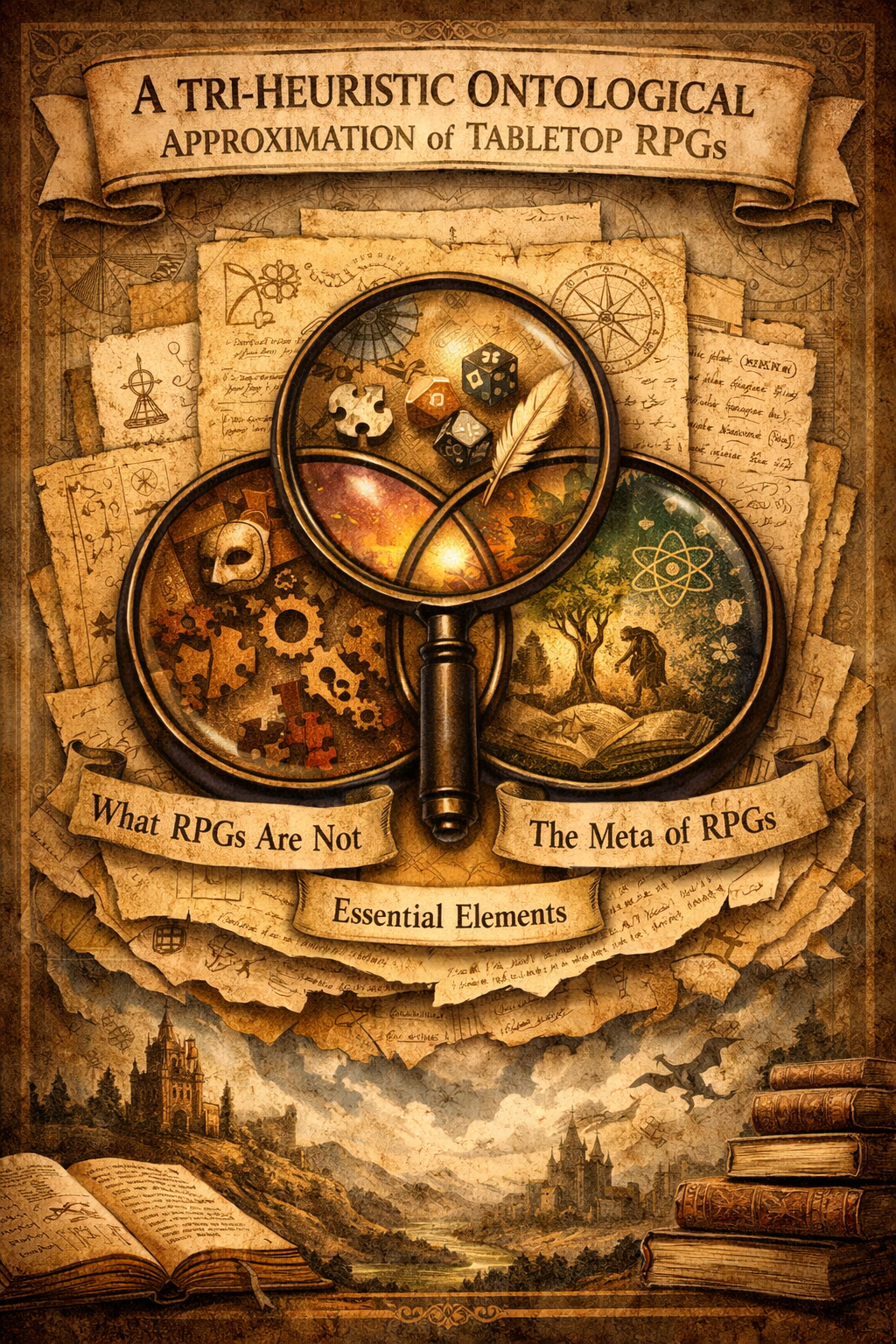
Tri-Heuristic Ontological Framework
The article introduces three heuristics as ontological points of departure. These heuristics do not function as exhaustive descriptors but as explanatory principles that illuminate the phenomenon from within.
- What RPGs Are Not: Analyzing common metaphors used to describe RPGs and how these metaphors simultaneously clarify and distort the phenomenon.
- Essential Elements: Identifying minimum theoretical and practical components that explain what happens when we play RPGs, including simulation and simulacrum, diegesis, interactive storytelling, organicity, ludic character, self-regulation mechanisms, and the palimpsest dimension.
- The Meta of RPGs: Exploring RPGs’ phenomenological capacity to cross boundaries between play, cognition, narrative, and worldview formation.
Contribution to RPG Studies
By framing RPGs through heuristics rather than definitions, the article offers a flexible theoretical starting point for multidisciplinary research. It invites dialogue across game studies, philosophy, narrative theory, and cognitive studies, particularly within Latin American scholarly perspectives on role-playing games.
Cite this Article
ISSN: 2643-7112
License: Creative Commons CC BY 4.0
Keywords:
ontology; heuristics; tabletop RPGs; game studies; metaphors; essential elements; RPG theory
Interested in Exploring or Collaborating?
If you are working on RPG theory, ontology, narrative systems, or interdisciplinary game studies,
📩 get in touch, share this post, or cite the article to expand theoretical conversations around role-playing games.
Versión en Español
Una Aproximación Ontológica Tri-Heurística a los Juegos de Rol de Mesa
Entrada de blog sobre el artículo publicado en
Analog Game Studies (2024).
Introducción
Los juegos de rol de mesa constituyen un objeto de estudio complejo, mutable y escurridizo. Este artículo propone abandonar la búsqueda de definiciones cerradas y adoptar una aproximación ontológica basada en heurísticas que permitan describir el fenómeno desde sus propias condiciones de posibilidad.
Aporte Principal
A través de tres heurísticas —lo que los RPGs no son, sus elementos esenciales y su dimensión meta— el texto ofrece un marco teórico abierto para el estudio interdisciplinario del rol, el juego, la narrativa y la cognición.