
By Cristo Leon.
Last reviewed January 23, 2026.
1. Introduction
In research and development administration, miscommunication rarely looks dramatic. It looks ordinary. A deadline shifts without notice. A scope change appears inside a budget justification. A sponsor requirement is misunderstood. A collaborator reads an email as criticism instead of coordination. A meeting ends with no decisions, and everyone leaves with a different interpretation of “next steps.”
These moments do not fail because people are incapable. They fail because high-interdependence work amplifies small communication errors. When every task depends on someone else’s timeline, approvals, compliance rules, and deliverables, even minor ambiguity becomes operational friction.
2. The Problem: Communication Turns Into Blame, Defensiveness, or Silence
Most workplace tension comes from a predictable pattern:
- Someone experiences a problem.
- They attempt to address it quickly.
- Their message is received as an accusation or a personal attack.
- The other person becomes defensive, disengages, or retaliates.
- The original issue remains unresolved and trust erodes.
This happens because people often speak in ways that unintentionally assign motive:
- “You never send documents on time.”
- “You don’t care about compliance.”
- “You’re not paying attention.”
- “You’re making this harder than it needs to be.”
Even when the underlying concern is valid, the framing escalates conflict. The listener hears character judgment, not process correction.
3. Augmenting the Problem: Why R&D Administration Makes This Worse
R&D administration is especially vulnerable to this dynamic because it is shaped by four structural conditions:
- Deadline intensity
Proposal submissions, internal routing, sponsor timelines, and compliance windows compress decision time. - Role interdependence
No single person controls the full workflow. PIs, departmental admins, research development, compliance, and sponsor systems all contribute to outcomes. - High accountability with partial authority
Many stakeholders are responsible for outcomes they cannot fully control. This creates chronic pressure and frequent friction. - Ambiguity and invisible complexity
A small change in language can trigger policy consequences, cost allowability issues, or sponsor rejection. Yet those implications are often not visible to everyone.
In this environment, communication needs to be precise, non-accusatory, and actionable. Otherwise, messages become noise or conflict.
4. The Solution: The “I Statement”
An “I statement” is a structured way to communicate a concern without escalating it into blame. It works because it keeps the message grounded in:
- your experience,
- a specific observable trigger,
- the impact on work,
- and a clear request.
It is not “soft communication.” It is high-precision communication designed for collaboration under constraints.
5. Definition: What an I Statement Is
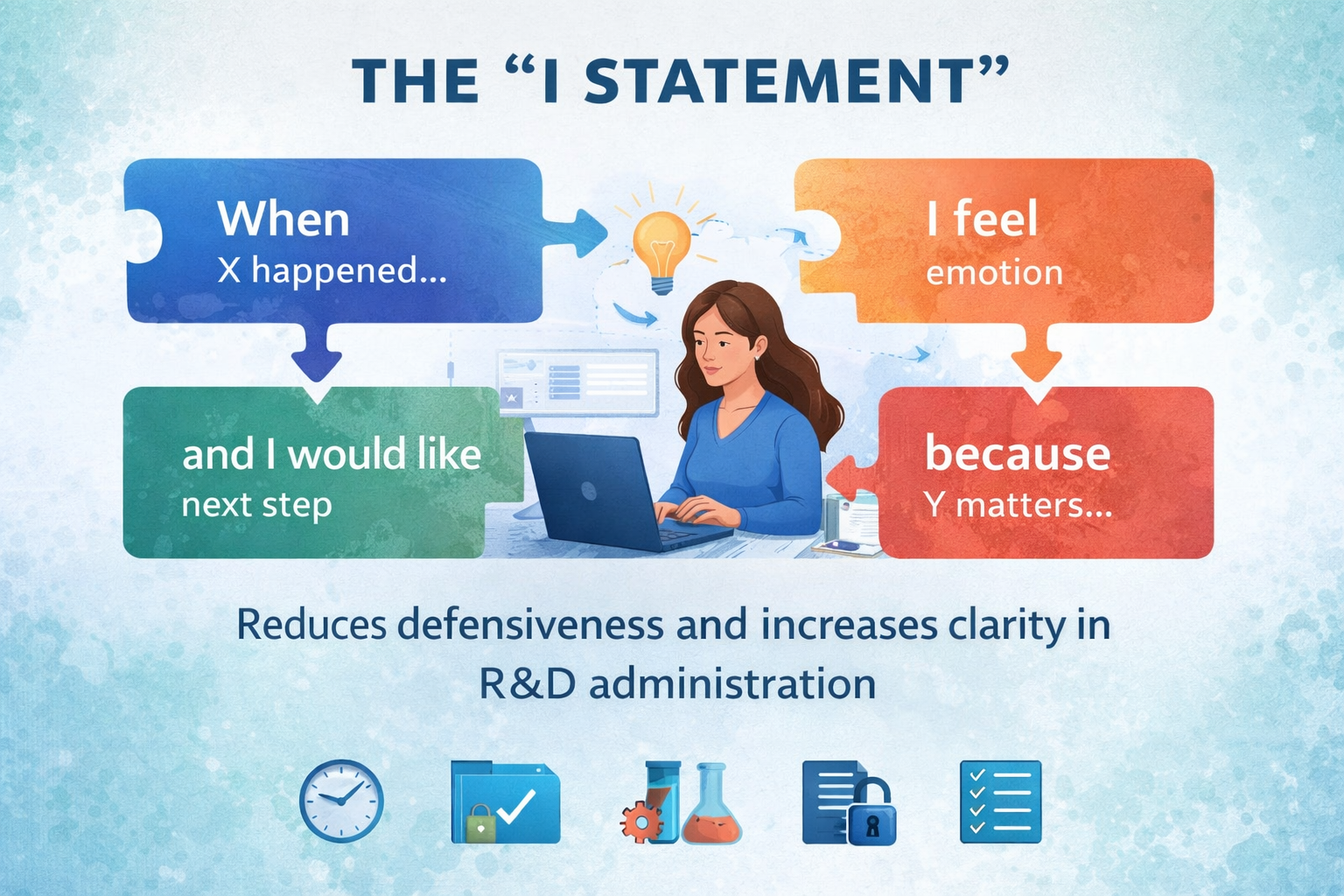
A basic I statement follows this sequence:
- I feel/am [emotion]
- when [specific situation]
- because [impact or need at stake]
- I would like [request / preferred next step]
Core principle: the «I Statement» targets behavior and process, not identity and motive.
5.1. Why this works
- It reduces defensiveness by removing implicit accusation.
- It creates a shared reference point (“when X happened…”).
- It clarifies operational impact (“because it affects Y…”).
- It ends with forward motion (“I would like Z…”).
6. The Improved Version: Cleaner, More Operational, More Effective
In professional settings, the strongest I statements are:
- concrete,
- time-bounded,
- and tied to outcomes.
Improved I Statement format (R&D-ready):
When [observable event], I feel [emotion], because [impact on deliverables/compliance/timeline], and I would like [specific next step + timeframe].
Optional upgrade:
If that’s not possible, [acceptable alternative].
This version keeps the message focused on execution, not emotion alone.
7. Five Examples for Research and Development Administration
7.1. Sponsor compliance and missing documents
When required sponsor documents are added after internal routing begins, I feel concerned because it increases compliance risk and can delay submission, and I would like all required attachments confirmed before the package enters final review.
7.2. Retroactive dates or period of performance confusion
When the project start date in the system differs from the period of performance in the Letter of Support, I feel uneasy, because it creates audit and sponsor alignment risk, and I would like us to confirm one authoritative date set and update all documents to match it.
7.3. Budget justification drifting into technical narrative
When technical details appear inside the budget justification, I feel cautious, because it can trigger unnecessary sponsor scrutiny and misalignment with allowable cost framing, and I would like technical language moved into the Statement of Work while keeping the justification strictly cost-rationale focused.
7.4. Last-minute scope changes without coordination
When scope changes are introduced within 24 hours of submission, I feel overloaded because it compresses review time and raises the probability of errors, and I would like any scope modifications flagged immediately in the shared thread with a brief summary of what changed and why.
7.5. Decision ambiguity after meetings
When meetings end without assigned owners or deadlines, I feel stuck, because I cannot execute follow-up tasks efficiently, and I would like us to close each meeting with three items: decisions made, assigned owners, and next deadlines.
8. A Final Note: I Statements Are a Governance Tool, Not a Therapy Tool
In administrative and research coordination contexts, I statements should not be treated as emotional disclosure. Their purpose is operational:
- to reduce defensiveness,
- to increase clarity,
- and to accelerate resolution.
They help you express tension without creating conflict. They also help teams treat problems as process failures to fix, rather than people failures to punish.
If you adopt one habit, make it this:
Name the behavior. Name the impact. Ask for the next step.
That combination moves work forward, preserves relationships, and protects outcomes.