
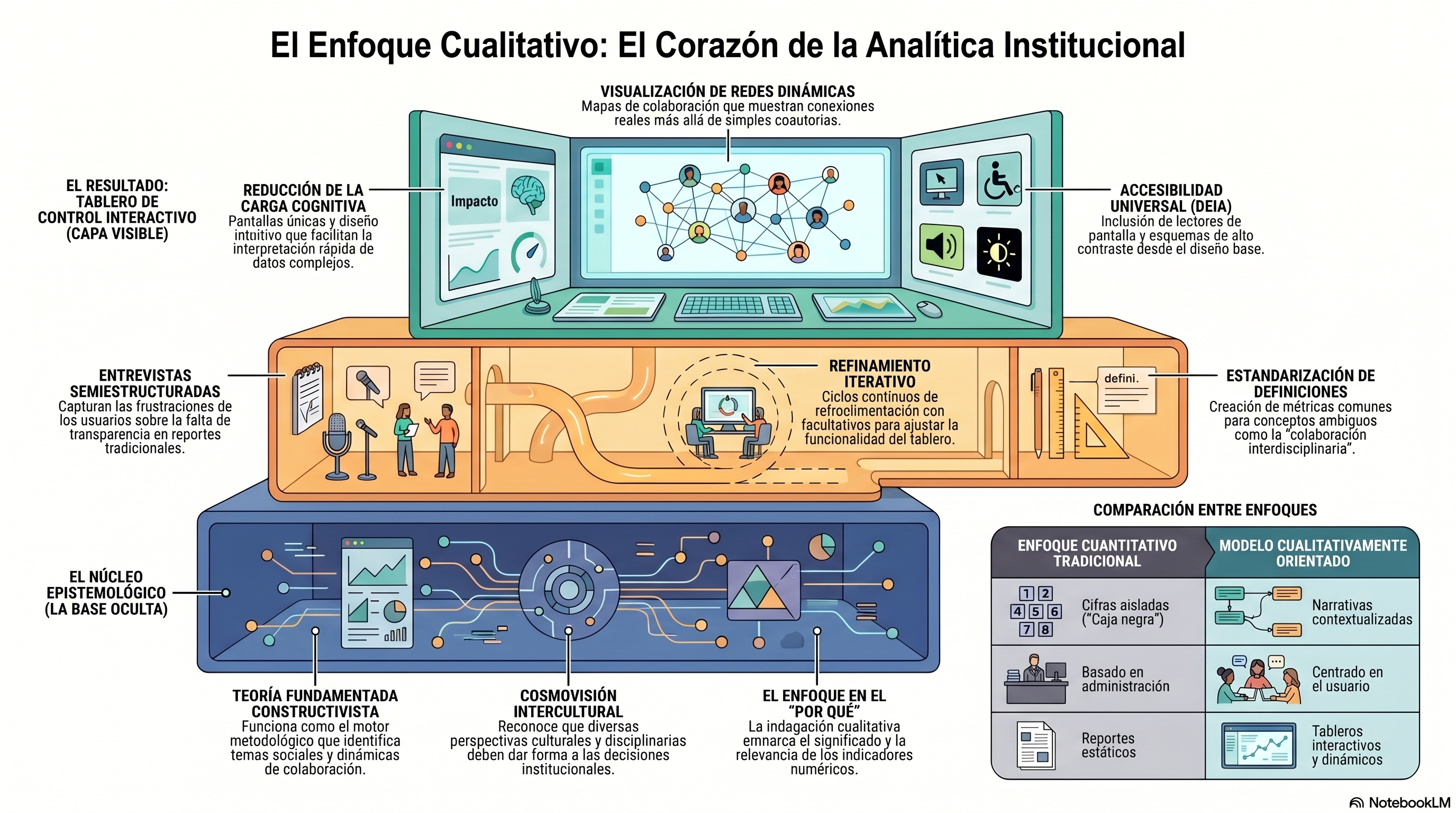
By: Cristo León, James Lipuma & Michelle Kudelka
Blog post about the article «A Qualitatively Driven Approach Integrated With Quantitative Analysis Applied to Decision Making in Institutional Administration of Higher Education» by León, Lipuma, and Kudelka (2026) published in the Brazilian Journal of Business, last updated on April 21, 206.].
Introduction
Institutional decision-making in higher education is often supported by dashboards, reports, and analytics systems that privilege quantitative indicators while minimizing the lived complexity of academic work. This article argues that such systems risk obscuring collaboration, institutional power dynamics, and the contextual factors that shape decision-making. In response, the study proposes a qualitatively driven mixed-methods approach that integrates qualitative insight with quantitative analysis in the design of institutional research infrastructure.
Methodological Approach
The study is grounded in Constructivist Grounded Theory (CGT) and thematic analysis. Semi-structured interviews with faculty and administrators were used to identify user needs, reveal institutional dynamics, and guide the iterative development of a Power BI dashboard. Rather than treating qualitative data as preliminary or secondary, the project positions it as the primary driver of system design and interpretive framing.
Designing a Context-Aware Dashboard
By integrating qualitative narratives with institutional research metrics, the resulting dashboard supports real-time exploration of collaboration networks, research productivity, and decision pathways. The article shows that data visualization becomes more ethically and operationally valuable when it reflects user experience, organizational context, and sociocultural realities instead of merely displaying aggregate metrics.
Key Findings
- Qualitative inquiry can reveal institutional needs and constraints that are invisible in numeric data alone.
- User-centered dashboard design improves usability, relevance, and interpretive legitimacy.
- Participatory feedback loops strengthen trust and increase the practical value of analytics tools.
- Methodological pluralism supports more ethical and context-aware decision systems in higher education.
Contribution
This article contributes a replicable model for integrating learning analytics, visualization, systems thinking, and qualitative research in the design of institutional technology. More broadly, it advances the argument that higher education administration requires sociotechnical reflexivity: systems should not only measure academic ecosystems, but also interpret them in ways that remain responsive to human meaning, power, and collaboration.
Cite this Paper
León, C., Lipuma, J., & Kudelka, M. (2026). A Qualitatively Driven Approach Integrated With Quantitative Analysis Applied to Decision Making in Institutional Administration of Higher Education. Brazilian Journal of Business, 8(2), e86731–e86731. https://ojs.brazilianjournals.com.br/ojs/index.php/BJB/article/view/86731
DOI: 10.34140/bjbv8n2-026
ISSN: 2596-1934
Volume: 8 | Issue: 2 | Pages: e86731–e86731
Publisher: Brazilian Journal of Business
Keywords: constructivist grounded theory; data visualization; institutional research; interdisciplinary collaboration; mixed-methods design; Power BI.
Interested in Exploring or Collaborating?
Are you working on institutional research, dashboard design, educational technology, or higher education decision-making? 📩 Get in touch, share this post, or cite the article to extend dialogue on qualitative analytics and institutional intelligence.
Copyright
© 2026 León, Lipuma & Kudelka. Published in the Brazilian Journal of Business.
Versión en Español
Un Enfoque Cualitativamente Guiado Integrado con Análisis Cuantitativo Aplicado a la Toma de Decisiones en la Administración Institucional de la Educación Superior
Entrada de blog sobre el artículo de León, Lipuma y Kudelka (2026) publicado en el Brazilian Journal of Business.
Introducción
Este artículo examina cómo los sistemas de análisis y visualización de datos en educación superior suelen privilegiar métricas cuantitativas y, al hacerlo, reducen la complejidad de la colaboración interdisciplinaria y de la toma de decisiones institucional. Frente a ello, el estudio propone un enfoque de métodos mixtos guiado cualitativamente que integra entrevistas, teoría fundamentada constructivista y análisis temático en el diseño de un tablero de Power BI.
Aporte Central
El estudio demuestra que incorporar narrativas cualitativas, necesidades de usuarios y bucles de retroalimentación participativa permite construir herramientas analíticas más éticas, útiles y sensibles al contexto. Así, la visualización de datos deja de ser un simple mecanismo de reporte para convertirse en una infraestructura interpretativa y reflexiva para la gobernanza académica.
Cita el artículo
León, C., Lipuma, J., & Kudelka, M. (2026). A Qualitatively Driven Approach Integrated With Quantitative Analysis Applied to Decision Making in Institutional Administration of Higher Education. Brazilian Journal of Business, 8(2), e86731–e86731. https://doi.org/10.34140/bjbv8n2-026