
By Cristo Leon, Ph.D.
Last reviewed: 10/20/2026
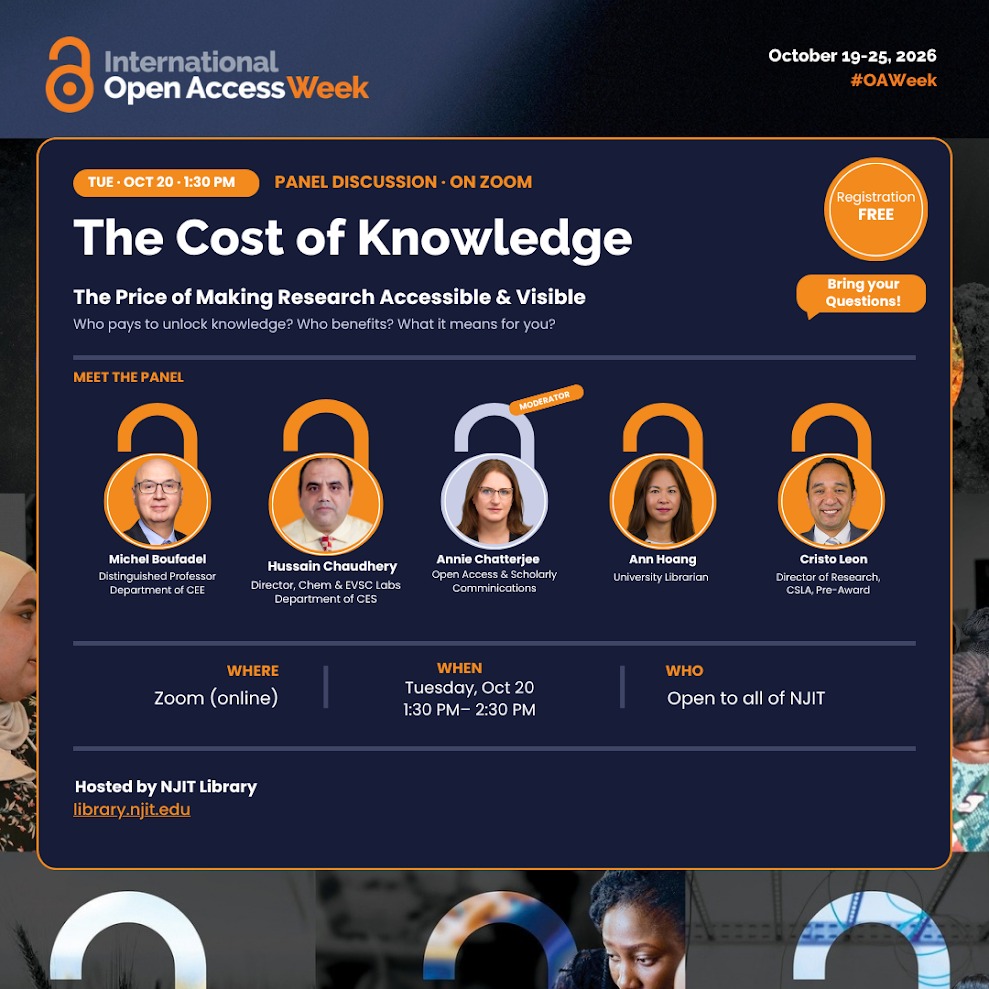
During International Open Access Week, I participated in NJIT’s panel, The Cost of Knowledge: Who Pays to Publish Research and Who Gets to Read It?, moderated by Annie Chatterjee, Open Access and Scholarly Communications Librarian at NJIT.
The panel brought together perspectives from faculty research, laboratory leadership, research development, and university libraries. Alongside Anne Hong, University Librarian; Chaudhry Hussain, Director of Chemistry and Environmental Science Laboratories; and Michel Boufadel, Distinguished Professor of Civil and Environmental Engineering, we examined the financial and institutional structures that shape scholarly communication.
The central question appeared simple:
What does knowledge actually cost?
But the discussion quickly demonstrated that the answer extends far beyond journal subscriptions or Article Processing Charges (APCs).
From a research-development perspective, the cost of knowledge begins long before a manuscript reaches a publisher. It includes the resources required to produce research, the labor required to validate it, the infrastructure required to publish and preserve it, and the financial barriers that determine who is able to read and contribute to the scholarly record.
The more useful question may therefore be:
How many times do we pay across the lifecycle of producing, validating, publishing, preserving, and accessing knowledge?
The Cost of Knowledge Begins Before Publication
Research is expensive before publication ever becomes part of the conversation.
Universities, governments, foundations, companies, and communities invest in personnel, laboratories, equipment, software, datasets, research participants, compliance systems, research administration, and institutional infrastructure.
Researchers contribute years of disciplinary expertise and intellectual labor.
Peer reviewers evaluate manuscripts, usually without compensation.
Editors provide intellectual and administrative labor that is frequently folded into broader academic responsibilities.
Libraries maintain databases, repositories, preservation systems, publishing agreements, and scholarly communication infrastructure.
Only after all of these investments have already occurred does a research output enter the publication system.
At that point, another financial transaction may appear.
An author may encounter an APC of several thousand dollars. A grant may absorb that cost. A department may provide support. A library may have negotiated a Read-and-Publish agreement. Or the researcher may decide that a particular journal is financially inaccessible.
The panel reinforced for me that there are at least four interconnected costs in scholarly communication.
Production costs include personnel, laboratories, equipment, data collection, software, participant recruitment, infrastructure, and research administration.
Publication costs include APCs, page charges, editing, repositories, persistent identifiers, preservation, and dissemination.
Labor costs include the often-uncompensated work of researchers, reviewers, editors, librarians, administrators, and others who sustain the scholarly record.
Opportunity costs arise when researchers decide where—or whether—to publish based not primarily on intellectual fit, readership, or scholarly value, but on what they or their institutions can afford.
This last category is especially important.
When financial capacity begins to determine where scholarship can appear, the cost of publishing stops being simply an accounting problem.
It becomes a question of equity in scholarly publishing.
Open Access Does Not Eliminate Cost
One of the clearest themes from the panel was this:
Open Access removes the price from the reader; it does not remove the cost from the system.
Someone still pays.
Depending on the model, the cost may migrate across the scholarly ecosystem:
reader → author → grant → department → library → institution → funder
Traditional subscription publishing places much of the visible cost on readers and libraries.
APC-based Open Access shifts more of the cost toward authors, research grants, and institutions.
Read-and-Publish agreements redistribute those costs through institutional arrangements.
The key issue is therefore not whether Open Access has a cost.
It does.
The more consequential question is:
Where does the system place that cost, and who is expected to absorb it?
Researchers often experience this as an individual decision:
Can I afford the APC?
Institutions should frame the problem differently.
Open dissemination is increasingly part of research infrastructure.
Read-and-Publish Agreements as Research Infrastructure
NJIT’s experience provides a concrete example.
During FY2025 and FY2026, the NJIT Library invested approximately $112,649 in Read-and-Publish agreements, resulting in approximately $721,336 in APC cost avoidance for NJIT researchers.
The program has subsequently expanded, including an agreement with IEEE.
These figures are significant, but their meaning extends beyond financial savings.
They represent publication decisions that individual researchers did not have to make based on whether they personally, their department, or their research grant could absorb an additional publication charge.
Chaudhry Hussain provided a particularly striking example during the panel. Through NJIT’s Open Access agreements, 43 of his Open Access articles represented approximately $116,000 in avoided APC charges over two years.
This demonstrates what institutional scholarly infrastructure can accomplish.
A Read-and-Publish agreement does more than negotiate a lower price.
It redistributes the financial risk of publication away from the individual researcher and toward a collective institutional mechanism.
That matters because the location of cost affects who is able to participate.
The Double-Payment Problem
The panel also returned to a persistent problem in traditional scholarly publishing.
Much research is publicly supported before publication.
Government agencies fund investigators.
Public universities provide laboratories and infrastructure.
Researchers conduct the work.
Peer reviewers evaluate it.
Then the resulting knowledge may enter a commercial publishing system in which universities, libraries, taxpayers, practitioners, or members of the public must pay again to access the findings.
The public may therefore help finance the production of knowledge and later be asked to finance access to that same knowledge.
Open Access attempts to address this problem by removing reader-facing barriers.
That is an important objective.
But simply moving the cost from the reader to the author does not automatically create a more equitable system.
It may instead create a different form of exclusion.
From Equity of Access to Equity of Participation
This was, for me, the most important implication of the discussion.
Open Access has correctly emphasized a fundamental question:
Who gets to read knowledge?
Subscription barriers have historically restricted access for researchers outside well-resourced universities, educators, practitioners, policymakers, community organizations, independent scholars, and members of the public.
Open Access challenges that barrier.
But discussions of Open Access and equity in scholarly publishing must also ask a second question:
Who gets to contribute knowledge?
APC-dependent publishing can create a financial barrier for authors.
Researchers with substantial federal awards may be able to include publication expenses in sponsored-project budgets.
Researchers without external funding may not.
This can disproportionately affect:
- early-career researchers;
- junior faculty;
- researchers between grants;
- scholars in disciplines with limited external funding;
- contingent or independently affiliated researchers;
- researchers at less-resourced institutions;
- scholars in lower-income countries;
- community-engaged researchers;
- interdisciplinary scholars whose work may not fit conventional funding structures.
The issue is structural.
The problem is not that a researcher failed to find $3,000 or $4,000 for an APC.
The problem arises when access to that money becomes a condition for participating in the scholarly record.
We should be careful that, in solving the paywall problem for readers, we do not create a paywall for authors.
This requires a broader understanding of equity.
Open Access should address both equity of access and equity of participation.
A genuinely open scholarly communication system should make it possible not only for people to read knowledge, but also for researchers to contribute knowledge without financial capacity determining whether their work becomes visible.
Open Access Is Not Synonymous With APCs
Another important point is that Open Access does not necessarily require an author-facing publication charge.
APC-based publishing is one model.
It is not the only model.
Diamond Open Access provides an important alternative.
Under Diamond Open Access, neither the reader nor the author pays an article-level fee. Publishing is instead supported through universities, libraries, scholarly societies, consortia, grants, volunteer academic labor, or combinations of these mechanisms.
As a journal editor, I find this distinction especially important.
Diamond Open Access does not mean that scholarly publishing becomes free.
Hosting costs money.
Editorial systems require maintenance.
DOIs must be registered.
Articles need to be archived and preserved.
Metadata must be created.
Web infrastructure must be maintained.
Editors and reviewers contribute expertise and labor.
The difference is not whether costs exist.
The difference is how those costs are distributed.
APCs make publication costs visible at the individual article level.
Diamond models attempt to distribute those costs across a broader scholarly infrastructure.
That model has its own sustainability challenges, but it demonstrates that author-pays publishing is not inevitable.
The Library Is Becoming Research Infrastructure
One of the most important themes in the panel was the evolving role of academic libraries.
Libraries have historically been understood primarily as gateways to knowledge.
They acquired journals, books, databases, archives, and other resources so that researchers and students could access the scholarly record.
That role remains essential.
But libraries now operate across a much broader portion of the research lifecycle:
discover → produce → manage → publish → preserve → disseminate → reuse
Libraries negotiate Open Access agreements.
They maintain institutional repositories.
They support research data management.
They provide copyright and licensing guidance.
They support persistent identifiers, preservation, research visibility, and scholarly publishing.
They are increasingly involved not only in providing access to knowledge after publication, but also in enabling researchers to produce and disseminate knowledge.
This suggests a significant institutional shift:
The academic library is evolving from being primarily a gateway to knowledge toward becoming infrastructure for the entire knowledge lifecycle.
That transformation has important implications for research development.
Open Access Should Begin Before Publication
From a research-development perspective, dissemination should not be treated as something that happens only after a project has ended.
When a research project is being designed, investigators and research administrators should already be considering:
- public-access requirements;
- data management;
- repository selection;
- publication strategy;
- dissemination audiences;
- research visibility;
- long-term preservation;
- community accessibility;
- potential reuse.
Open Access should therefore not be an administrative afterthought attached to a finished manuscript.
It should increasingly be incorporated into research design.
This requires stronger connections among investigators, research development professionals, libraries, sponsored research offices, and scholarly communication specialists.
Rather than viewing publication as the final transaction in a project, universities can approach knowledge production as a lifecycle.
Funding enables research.
Research generates knowledge.
Peer review evaluates it.
Publication communicates it.
Repositories preserve it.
Open dissemination expands its audience.
Reuse allows that knowledge to generate additional scholarly and societal value.
The Cost of Knowledge We Do Not Share
There is another cost that deserves more attention:
the cost of knowledge that is produced but never effectively disseminated.
Consider the investment required to conduct publicly supported research.
Researchers are supported.
Laboratories operate.
Participants contribute data and time.
Universities provide infrastructure.
Research administrators support compliance and project management.
Libraries provide information resources.
Public agencies invest taxpayer resources.
If the resulting knowledge cannot subsequently be discovered, accessed, evaluated, reused, replicated, taught, or translated into practice, then the social return on that investment is reduced.
This changes how dissemination should be understood.
Dissemination is not something that happens after research.
It is part of completing the research lifecycle.
Publication, discoverability, accessibility, and preservation are therefore not peripheral expenses.
They are part of the infrastructure through which research achieves scholarly and societal value.
Open Access, Visibility, and Global Reach
The panel also highlighted the relationship between Open Access and research visibility.
Making research openly available expands its potential audience beyond scholars whose institutions can afford subscriptions to specific journals.
This has particular importance for the global research community.
The audience for scholarly research includes:
- researchers at smaller institutions;
- scholars in countries with limited subscription access;
- educators;
- practitioners;
- policymakers;
- nonprofit organizations;
- community partners;
- students;
- independent researchers;
- members of the public.
Removing reader-facing barriers does more than increase accessibility.
It expands the scholarly and societal networks through which knowledge can circulate.
For universities concerned with research impact, Open Access is therefore not only a compliance issue.
It is also part of research visibility, collaboration, dissemination, and impact.
Open Access Can Reduce Other Forms of Risk
Another valuable point raised during the panel concerned predatory publishing.
Researchers under pressure to publish may encounter aggressive solicitations from journals offering rapid publication in exchange for substantial fees.
Institutionally supported Open Access options can help reduce that vulnerability.
When universities provide researchers with clearly identified pathways to legitimate Open Access publishing, they do more than cover publication costs.
They provide trusted scholarly infrastructure.
Read-and-Publish agreements, library guidance, institutional repositories, and scholarly communication expertise can help researchers distinguish legitimate publication opportunities from exploitative ones.
This support is particularly important for early-career researchers, scholars entering unfamiliar interdisciplinary fields, and investigators navigating publication systems outside their primary discipline.
Moving Beyond Article-by-Article Transactions
If I could change one feature of the current scholarly publishing system, I would reduce our dependence on article-by-article financial transactions.
Under traditional subscription publishing, the reader encounters a financial gate.
Under APC-dependent Open Access, the author encounters a financial gate.
The location of the transaction changes, but scholarly communication remains structured around individual points of financial exclusion.
A more sustainable model would increasingly treat scholarly communication as shared research infrastructure.
That transition requires responsibility across the entire research ecosystem.
Researchers should make informed decisions about publication venues, licensing, copyright, and rights retention.
Universities should recognize dissemination and preservation as components of the cost of conducting research.
Libraries should continue negotiating collective agreements while expanding repositories, publishing platforms, preservation systems, and scholarly communication services.
Funding agencies should recognize dissemination as a legitimate research expense while remaining attentive to whether unlimited APC reimbursement contributes to escalating publication prices.
Publishers should provide greater transparency about pricing and demonstrate what publication charges actually support.
And the academic community should continue developing alternatives, including institutional repositories, scholarly societies, consortial models, university publishing, and Diamond Open Access.
The goal should not simply be cheaper articles.
The goal should be a scholarly communication system in which financial capacity does not determine either the ability to read research or the ability to contribute to it.
From the Price of an Article to the Infrastructure of Knowledge
What I appreciated most about the panel was that the conversation moved beyond the question of whether Open Access is inherently good or bad.
That is increasingly the wrong question.
The more useful questions are:
- Who pays?
- At what point in the research lifecycle?
- Who bears the financial risk?
- Who gains access?
- Who is excluded?
- What forms of scholarly labor remain invisible?
- And what kind of infrastructure do universities want to build around knowledge production?
Three ideas stayed with me after the discussion.
Open Access removes the price from the reader; it does not remove the cost from the system.
We need to think not only about equity of access to knowledge, but also about equity of participation in producing knowledge.
And:
We should not solve the paywall for readers by creating a paywall for authors.
These principles move the conversation beyond APCs and toward a larger discussion about Open Access and equity in scholarly publishing.
Publicly supported research should contribute to a durable public knowledge infrastructure.
That infrastructure will not be free.
Research has never been free.
Publishing is not free.
Libraries are not free.
Repositories, preservation, peer review, editorial work, and research administration all require resources and labor.
The critical policy question is therefore not whether we can eliminate the cost of knowledge.
We cannot.
The question is how those costs should be distributed so that financial barriers do not determine who gets to read knowledge, who gets to produce it, or whose knowledge ultimately becomes part of the scholarly record.