
By Cristo Leon, Ph.D.
Last reviewed: 10/28/2026.
Research Infrastructure Is Also Educational Infrastructure: Why Faculty Must Think Beyond the Experiment
Faculty often approach research infrastructure through a straightforward question:
What equipment do I need to conduct the research?
That question is necessary, but it is increasingly insufficient.
A laboratory, instrument, beamline, computing platform, or specialized facility is not valuable only because it allows a principal investigator to complete an experiment. Research infrastructure also determines who can participate in research, what technical capabilities they develop, how expertise is transmitted across career stages, and whether discoveries can move beyond the university into government, industry, and society.
The more consequential question is therefore not simply:
What can this equipment do?
It is:
What research ecosystem becomes possible because this infrastructure exists?
This distinction matters because research infrastructure is not simply a collection of expensive instruments. When designed intentionally, it can become scientific infrastructure, educational infrastructure, workforce infrastructure, and technology-translation infrastructure at the same time.
From Equipment to Research Infrastructure
There is an important conceptual distinction between equipment and research infrastructure.
Equipment is a tool.
A facility is the physical and organizational environment in which that tool operates.
Research infrastructure is the integrated system of equipment, facilities, software, technical expertise, access mechanisms, workflows, partnerships, and people that makes sustained research possible.
This distinction changes how faculty should think about investments in instrumentation.
Consider an advanced characterization system. A traditional facilities description might emphasize spectral range, spatial resolution, temporal resolution, operating temperature, sensitivity, or analytical precision.
Those specifications matter scientifically.
But they do not, by themselves, explain the broader value of the investment.
The more important question is what becomes possible because of those capabilities.
A new instrument may allow researchers to characterize materials that could not previously be measured adequately. It may reduce uncertainty during device development. It may create new opportunities for validation, collaboration, commercialization, or defense-relevant applications.
It may also create something equally important:
a developmental pathway through which students become researchers.
Research Infrastructure Can Support Multiple Levels of Technical Engagement
Research infrastructure does not need to serve every user at the same level of complexity.
An undergraduate researcher does not need to perform the most technically sophisticated experiment in the laboratory to benefit meaningfully from the research environment.
Instead, participation can be structured progressively.
Undergraduate students may begin with sample preparation, laboratory procedures, safety, documentation, basic instrumentation, and introductory data acquisition.
Graduate students may conduct systematic materials characterization, compare measurement modalities, analyze experimental data, and connect observations with theoretical or computational models.
Doctoral students and postdoctoral researchers may conduct advanced experiments involving specialized spectroscopy, cryogenic environments, high-resolution measurements, dynamic characterization, or other technically demanding procedures.
Senior investigators may integrate those results into fundamental scientific questions, external collaborations, technology-development programs, and strategic research partnerships.
The same research infrastructure therefore supports a continuum:
Foundational technical engagement → characterization and analysis → advanced experimentation → research leadership
This is not merely training in the conventional sense.
It is the progressive development of research capability.
Students Should Not Be an Afterthought in Research Infrastructure Proposals
Faculty often treat education as something that must be added to a research proposal after the scientific argument has already been developed.
The research comes first.
Then, near the end, appears a paragraph explaining that students will benefit.
That approach misses a major opportunity.
Students can instead be understood as users of the research infrastructure itself.
If an institution already has undergraduate research programs, honors research experiences, summer research institutes, graduate research assistantships, postdoctoral programs, or related mechanisms, those programs represent an existing pipeline through which researchers enter the scientific environment.
The relevant question then becomes:
How does the proposed infrastructure strengthen that pipeline?
That framing is substantially stronger than simply saying that students will “gain research experience.”
Faculty should identify what students will actually learn to do.
- Will they learn instrumentation?
- Experimental design?
- Sample preparation?
- Data acquisition?
- Quantitative analysis?
- Research documentation?
- Validation?
- Reproducibility?
- Interdisciplinary communication?
- Technology translation?
Once these competencies become explicit, the educational purpose of research infrastructure becomes visible.
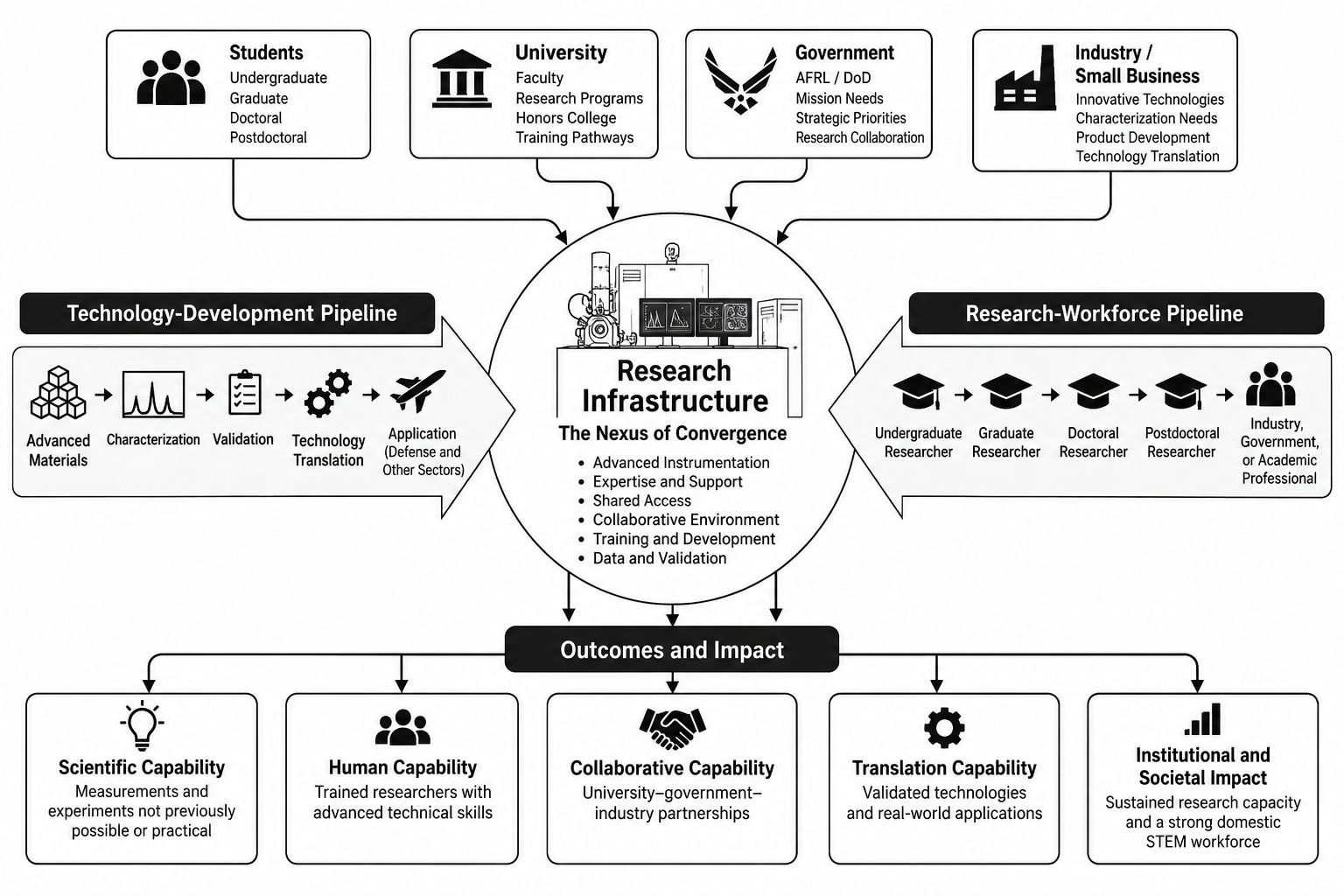
Two Pipelines Can Intersect at the Research Infrastructure
One useful way to understand this relationship is through two simultaneous pipelines.
The first is a technology-development pipeline:
Advanced materials → characterization → validation → technology translation → application
The second is a research-workforce pipeline:
Undergraduate researcher → graduate researcher → doctoral researcher → postdoctoral researcher → industry, government, or academic professional
Research infrastructure can become the point at which these pipelines intersect.
This is a critical distinction.
Students are not simply observing research while technology development occurs somewhere else.
They are participating in the processes through which materials are characterized, hypotheses are tested, technologies are validated, and applications are developed.
A student who learns how to operate an instrument gains a technical skill.
A student who understands why a measurement is required, how the resulting data affect a research decision, and how that decision influences the development of a technology is learning something much broader.
They are learning how a research system functions.
Research Infrastructure as a Site of Convergence
This perspective also reveals why research infrastructure can become a site of convergence research.
Imagine a university research environment in which several communities interact:
- undergraduate and graduate researchers developing technical competencies;
- faculty and postdoctoral researchers conducting advanced investigations;
- government laboratories identifying mission-relevant research needs;
- small businesses developing new technologies but lacking access to highly specialized characterization capabilities; and
- institutional programs creating pathways through which new researchers enter the system.
None of these elements is particularly transformative in isolation.
Their value emerges through interaction.
The laboratory becomes a nexus.
“Research infrastructure becomes convergence infrastructure when it connects scientific capability, workforce development, institutional collaboration, and technology translation within a shared research environment.”
— Cristo León, Ph.D., 2026
Government identifies a research need.
Faculty develop the science.
Research infrastructure enables characterization.
Students learn within the research process.
Small businesses gain access to capabilities that help reduce technical uncertainty.
Validated technologies move closer to practical application.
Students who have participated in that environment eventually enter government, industry, academia, or entrepreneurship with a deeper understanding of the complete research-development process.
That is much more consequential than acquiring an isolated piece of equipment.
Educational Infrastructure and Technology Translation Are Connected
Faculty also benefit from recognizing that educational development and technology translation do not need to be treated as separate outcomes.
Consider a small business developing an emerging material, component, or device.
The company may possess the intellectual property and technical expertise required to create a promising prototype but lack the capital needed to maintain every advanced characterization capability internally.
University research infrastructure can help reduce that barrier.
Advanced characterization allows the company to ask questions such as:
Does the material behave as predicted?
Can the measurement be reproduced?
How does performance change under different operating conditions?
What design characteristics need to be modified?
Is the prototype sufficiently understood to move toward further development?
These questions connect research directly to technology translation.
Students participating in these collaborations are exposed to processes that are difficult to reproduce through classroom instruction alone.
They encounter the sequence:
measurement → evidence → decision → redesign → validation → application
That is experiential research education at an advanced level.
Advanced Characterization Reduces Uncertainty
One particularly important function of research infrastructure is its ability to reduce uncertainty.
Technology translation does not occur simply because a new material or device appears promising.
Translation requires evidence.
Advanced characterization can provide that evidence.
It helps researchers determine whether a material behaves consistently, whether a device performs under relevant conditions, whether observed effects are reproducible, and whether a prototype is ready for additional development.
This produces a powerful pathway:
Advanced materials → advanced characterization → reduced uncertainty → validation → technology translation → application
The educational pipeline develops in parallel:
Undergraduate → graduate → doctoral → postdoctoral → industry or government professional
When both pipelines intersect at a well-designed research facility, infrastructure becomes more than technical capacity.
It becomes a mechanism for producing both knowledge and people capable of advancing that knowledge.
Faculty Should Design the Research Environment, Not Only the Experiment
Faculty understandably concentrate on whether an instrument will generate the measurements necessary to answer a particular research question.
But faculty are also designing an environment.
- Where will new researchers enter?
- What will they learn first?
- What responsibilities can they assume next?
- How will expertise move from senior researchers to junior researchers?
- How will students interact with external partners?
- How will researchers connect fundamental science to practical applications?
- Who will be able to use the infrastructure after the original project ends?
These questions do not weaken the scientific argument.
They strengthen the sustainability of the research investment.
Research Infrastructure Can Produce Multiple Forms of Capacity
The strongest infrastructure investments generate several forms of capacity simultaneously.
They increase scientific capability by enabling measurements or experiments that were previously impossible, unavailable, or insufficiently precise.
They increase institutional capability by creating resources that can support multiple projects, investigators, and collaborations.
They increase human capability by developing researchers who can use increasingly sophisticated methods.
They increase collaborative capability by creating shared environments around which universities, government laboratories, and industry partners can interact.
They increase translation capability by helping move discoveries from scientific observation toward validated technologies and applications.
The central argument is therefore simple:
Research infrastructure should not merely enable better experiments. It should enable better research systems.
Why Faculty Should Care About the Educational Purpose
There is also a strategic reason faculty should care about the educational dimension of research infrastructure.
A piece of equipment can become obsolete.
A research ecosystem can reproduce itself.
Undergraduate students trained within one project become graduate researchers.
Graduate students become postdoctoral scholars.
Postdoctoral researchers become faculty members, government scientists, industry researchers, or entrepreneurs.
Small businesses become collaborators.
Collaborators generate new research questions.
New research questions create new opportunities for students.
Research infrastructure therefore creates a multiplier effect when faculty intentionally connect scientific capability with research workforce development.
This is why education should not be treated as an obligation added at the end of a proposal.
It is part of the research system itself.
Beyond the Experiment
The most compelling faculty vision is not:
“I need this instrument to perform my experiment.”
It is:
“Research infrastructure should enable work that cannot currently be performed while creating pathways for students, researchers, government partners, and industry to develop new knowledge and technology together.”
— Cristo León, Ph.D., 2026
That difference matters.
The first statement describes a purchase.
The second describes an ecosystem.
The first focuses on the immediate project.
The second focuses on sustained research capacity.
The first asks what the equipment can do.
The second asks what the infrastructure can make possible.
Faculty who think in this broader way are not diminishing the importance of technical excellence.
They are recognizing that the most consequential research environments do more than produce measurements.
They produce knowledge, capabilities, partnerships, technologies, and researchers.
That is why research infrastructure should also be understood as educational infrastructure.