
What Can You Contribute? The Knowledge, Skills, and Value (KSV) Framework in Higher Education
By Cristo León, Ph.D.
Last reviewed: November 12, 2026
From disciplinary knowledge to meaningful contributions beyond the classroom.
The Problem: What Have You Learned, and Why Does It Matter?
After more than two decades of working with university students, professionals, and executives, I have encountered a persistent question that appears deceptively simple: What can you contribute?
For experienced professionals, answering this question is not always straightforward. For university students approaching graduation, it can be considerably more difficult.
Consider a classroom of undergraduate juniors and seniors representing twelve different academic disciplines. Some students envision careers in large corporations. Others aspire to become educators, researchers, public servants, or entrepreneurs. Some are preparing for graduate studies, while others remain uncertain about their next steps. Their academic preparation, personal experiences, disciplinary languages, and professional aspirations differ substantially.
Now imagine asking everyone in that classroom to complete the same assignment: Identify your professional aspirations, explain your expertise, and demonstrate the value you could bring to an organization.
At first glance, the task appears reasonable. Higher education should prepare students to recognize and communicate their capabilities. Yet the diversity of the classroom makes this assignment extraordinarily difficult to design and assess.
A student studying computer science may envision developing software for a multinational corporation. A biology student may anticipate working in a research laboratory. A humanities student may aspire to teach, while an engineering student may want to establish a business. Each student operates within a different disciplinary context and anticipates a different professional environment.
What constitutes relevant knowledge in one field may not translate directly into another. What counts as a meaningful contribution in research may differ from the expectations of entrepreneurship, education, or industry.
The instructional challenge is therefore not simply accommodating different career interests. It is developing a shared learning experience that allows students to recognize, articulate, and communicate the value of their education without imposing a single professional trajectory.
This challenge led me to reconsider a fundamental assumption in my teaching: Perhaps students should not begin by describing the professionals they hope to become. Perhaps they should begin by identifying what they already know, what they can demonstrably do, and how those capabilities could benefit another person.
Amplifying the Problem: When Career Aspirations Obscure Learning
My experience in higher education and executive development has shown me that individuals frequently struggle to distinguish what they know, what they can do, and why those capabilities matter to others.
This challenge becomes particularly visible when university students are asked to describe their professional value.
Some immediately focus on perceived deficiencies. A low grade point average becomes evidence that they will struggle to find employment. The absence of an internship becomes an indication that they have no relevant experience. Uncertainty about a career becomes uncertainty about whether they have learned anything useful.
These concerns are legitimate, particularly for students approaching graduation and facing financial, professional, and personal pressures. However, they can narrow the student’s attention to immediate barriers rather than encourage reflection on their educational development.
Other students respond by describing aspirations instead of capabilities. They identify prestigious employers, ambitious career titles, or entrepreneurial ventures without explaining the knowledge and skills that would enable them to contribute meaningfully.
The distinction matters.
Wanting to work for a technology company does not demonstrate technological knowledge. Aspiring to establish a business does not establish entrepreneurial competence. Expressing interest in teaching does not necessarily demonstrate the ability to explain a complex concept to someone encountering it for the first time.
These aspirations may provide motivation, but they are not evidence of learning.
In my teaching, I have experimented with assignments that ask students to identify prospective employers, investigate organizational structures, and describe their future professional roles. Although these activities can produce valuable outcomes, they also introduce complications in multidisciplinary classrooms.
Students with internships or established professional connections may reproduce the responsibilities they already perform. Students without those opportunities may construct idealized positions around their aspirations. Others may select organizations from examples provided in instructional materials without independently investigating whether those organizations or positions remain relevant.
The assignment can gradually shift from examining the student’s learning to describing an external organization.
Generative artificial intelligence adds another layer of complexity.
Students can now generate sophisticated descriptions of professional responsibilities, organizational structures, desirable competencies, and career pathways in seconds. A well-written response may accurately characterize an occupation while revealing very little about the student’s actual understanding.
The challenge is not simply that students use AI. These technologies can support exploration, communication, and reflection. The instructional problem arises when an assignment allows students to substitute a plausible professional narrative for evidence of their own learning.
A student may submit an excellent description of what an engineer, researcher, educator, or entrepreneur does without demonstrating the knowledge or skills necessary to perform any of those activities.
This creates a fundamental problem for assessment.
Are we evaluating what students have learned, or are we evaluating their ability to describe what someone else does?
If the educational objective is to develop and communicate disciplinary understanding, asking students to imagine a future position may not be the most productive starting point.
Instead, we need an approach that begins with the learner’s existing capabilities and progressively connects those capabilities to meaningful applications.
The Proposed Solution: Knowledge, Skills, and Value (KSV)
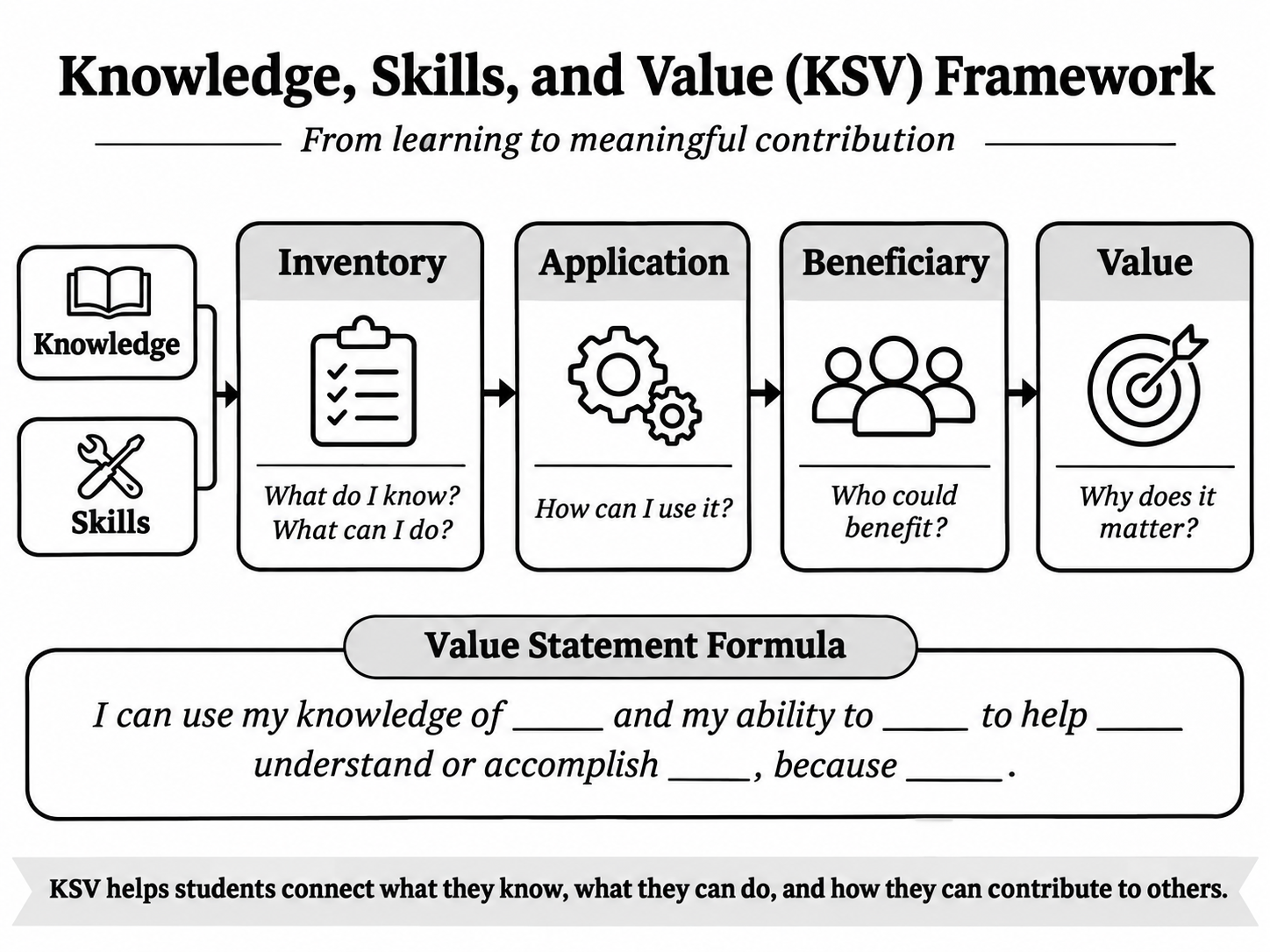
The Knowledge, Skills, and Value (KSV) Framework is a proposed instructional approach designed to help learners identify their capabilities, connect them to meaningful applications, and articulate their potential contributions to others.
KSV emerged from the practical challenge of developing a shared learning experience for students with diverse disciplinary backgrounds and professional aspirations.
Its central proposition is straightforward: Before students can communicate their professional or social value, they must be able to distinguish what they know from what they can do and explain why either matters to someone else.
The framework is organized around three interconnected constructs: Knowledge, Skills, and Value.
Knowledge: What Do I Know?
Knowledge refers to the concepts, theories, principles, methodologies, and disciplinary understandings an individual has acquired through formal education and other learning experiences.
It involves more than recognizing terminology or recalling information. Meaningful disciplinary knowledge includes the capacity to explain ideas, understand their relationships, recognize relevant assumptions, and identify appropriate contexts for their application.
For example, a biology student may understand the principles of cellular metabolism. A communication student may understand theories of interpersonal communication. A computer science student may understand algorithmic complexity.
These forms of knowledge are not interchangeable, nor should they be treated as equivalent. Each represents a distinct intellectual contribution developed through disciplinary learning.
The initial question is not whether one field is more valuable than another. It is whether the student can identify and explain the knowledge they claim to possess.
Skills: What Can I Do?
Skills refer to capabilities that an individual can demonstrate through action.
These may involve technical procedures, analytical methods, communication practices, creative processes, research techniques, or collaborative activities.
A student may understand the principles of statistical analysis without being able to conduct an appropriate analysis independently. Another may know how to operate statistical software without understanding the assumptions underlying a particular analytical method.
Similarly, knowing the principles of effective communication does not automatically establish the ability to design and deliver an effective presentation.
KSV therefore distinguishes conceptual understanding from demonstrated performance.
The student must move beyond identifying a skill to explaining how it can be applied and what evidence supports the claim.
Academic projects, laboratory exercises, presentations, research assignments, creative productions, and collaborative activities can provide such evidence.
Students do not need to claim professional expertise. They need to identify capabilities they have developed sufficiently to apply and substantiate those claims through specific examples.
Value: Why Does It Matter?
Value refers to the meaningful benefit that knowledge and skills may generate for another person, group, community, or organization.
Within KSV, value is relational and contextual.
Knowledge does not automatically become valuable merely because an individual possesses it. Likewise, a skill does not necessarily represent a meaningful contribution simply because someone can perform it.
The potential value becomes clearer when a capability is connected to a need, question, problem, or desired outcome.
A student who understands statistical interpretation and can create accessible visualizations might help members of a community understand public health information.
A student who understands principles of communication and can develop instructional materials might help others recognize misinformation.
An engineering student who understands basic design principles and can construct a prototype might help demonstrate a possible solution to a practical challenge.
In each case, the contribution emerges from the relationship between knowledge, capability, application, and beneficiary.
KSV does not assume that all contributions must produce economic value. A contribution may improve understanding, facilitate participation, support informed decisions, increase accessibility, or strengthen communication.
This broader conception is particularly important in classrooms where students anticipate careers in education, research, public service, industry, and entrepreneurship.
The framework provides a common structure without requiring a common professional destination.
From Inventory to Contribution: Four Instructional Steps
The KSV Framework is operationalized through four connected instructional steps: Inventory, Application, Beneficiary, and Value.
These steps guide students from identifying their capabilities to explaining their potential significance to others.
Step 1. Inventory: What Do I Know, and What Can I Do?
Students begin by identifying three bodies of knowledge, concepts, or methodologies that they believe they understand sufficiently to explain and apply.
They also identify three skills they claim to have developed to the point of independent application.
For each item, students respond to a small set of questions.
For knowledge, they explain what the concept or methodology is, what it helps them understand, and where they learned it.
For skills, they describe what they can do, how they would demonstrate that capability, and what specific activity supports their claim.
This inventory is deliberately grounded in the student’s educational experiences rather than an imagined professional future.
Students may draw evidence from coursework, laboratory activities, independent projects, research, creative work, collaborative assignments, or community engagement.
The objective is not to produce an impressive list of capabilities. It is to encourage an accurate and defensible account of what the student has learned.
The inventory also creates opportunities to identify gaps between perceived competence and demonstrated ability.
A student may initially claim to have mastered public speaking but struggle to identify a specific occasion when they adapted a presentation for a particular audience. Another may identify proficiency in data analysis but recognize that their experience is limited to following established procedures.
These discoveries are not necessarily failures. They provide information for reflection and further development.
Step 2. Application: What Can I Accomplish?
After completing the inventory, students select one area of knowledge and one skill that could be combined to perform a meaningful task.
This step shifts attention from possession to application.
Knowing the principles of communication differs from developing an effective presentation. Understanding environmental science differs from using scientific evidence to explain a community concern. Studying programming languages is not the same as developing a functional tool that addresses a defined problem.
Students must describe what they could accomplish, how they would approach the task, and which capabilities the task would require.
The emphasis moves from listing academic achievements to explaining the practical possibilities of disciplinary learning.
Importantly, the application does not need to involve an employer or professional position.
It may involve explaining a scientific concept, interpreting information, supporting a decision, designing a resource, demonstrating a process, or helping another person understand an unfamiliar subject.
Step 3. Beneficiary: Who Could Benefit?
The third step introduces the intended beneficiary.
Students identify a person or group that could benefit from the application of their knowledge and skills.
The beneficiary might be another student, a family member, a teacher, a community organization, a research team, or a member of the general public.
Students then consider what this person or group needs to understand or accomplish.
What question might they have? What misconception could prevent them from understanding the topic? What challenge might they encounter? What information would help them make a more informed decision?
This step introduces perspective-taking into the process.
The student must move beyond describing personal capabilities and consider the circumstances, knowledge, and needs of another person.
For a multidisciplinary classroom, this is especially valuable because it provides a common communication challenge that does not depend on disciplinary uniformity.
Students may select entirely different topics, but each must explain how their knowledge could become meaningful to someone outside their immediate field.
Step 4. Value: Why Does My Contribution Matter?
The final step integrates the previous three into a concise value statement.
Students connect their disciplinary knowledge, applicable skills, intended beneficiary, and anticipated contribution.
A basic formulation is:
I can use my knowledge of [subject] and my ability to [skill] to help [beneficiary] understand or accomplish [objective], because [reason the contribution matters].
For example:
I can use my knowledge of statistical interpretation and my ability to create accessible visualizations to help community members understand public health information, because clear representations of data can support more informed decisions.
This statement does not require the student to claim professional experience they may not possess. It does not depend on a hypothetical employment opportunity or a prestigious organizational affiliation.
Instead, it establishes a relationship between learning, capability, and anticipated benefit.
The distinction between potential and demonstrated value is important.
The statement is not proof that the contribution has already occurred. It is a reasoned proposition that can subsequently be tested, demonstrated, revised, or translated into a concrete educational activity.
Its immediate purpose is to help students recognize that the significance of their learning extends beyond grades, credentials, and future job titles.
The Transformation: From Academic Identity to Meaningful Contribution
The potential of KSV extends beyond preparing students for employment.
Its more significant pedagogical contribution may be changing how learners interpret their educational experiences.
A student who begins by stating, «I do not have enough experience to obtain a job,» may discover that their university education has already provided opportunities to develop demonstrable knowledge and skills.
A student who identifies exclusively with a future job title may begin to recognize capabilities that could be applied across multiple professional environments.
A student uncertain about their career path may discover that articulating a meaningful contribution does not require knowing precisely where they will work after graduation.
This transformation is particularly relevant in multidisciplinary classrooms.
When students represent twelve different academic disciplines, their disciplinary content cannot reasonably be standardized. However, the reflective processes through which they identify knowledge, substantiate skills, examine applications, and articulate value can be shared.
KSV does not eliminate disciplinary differences. It provides a common structure through which those differences can become visible and productive.
The framework also offers a practical bridge toward effective communication.
Once students identify an area of knowledge, an applicable skill, and an intended beneficiary, they can develop an explanation designed for a nonexpert audience.
They might identify a common misconception, construct an analogy, select appropriate visual evidence, and produce an explanatory presentation or video.
For example, a student studying computer science may identify a misconception about artificial intelligence. A biology student may explain a misunderstood biological process. A mathematics student may address a common error in interpreting probability. A humanities student may clarify a misconception about historical interpretation.
Their disciplinary subjects differ, but their communication responsibilities share a common structure.
Each student must understand a subject, identify an audience, recognize a gap in understanding, and construct an explanation that makes the subject accessible without compromising its accuracy.
The resulting presentation is no longer simply an assignment about a topic selected from a course syllabus.
It becomes an opportunity to demonstrate how disciplinary learning can contribute to another person’s understanding.
This is where KSV may support a broader educational transformation: from asking students to describe their expertise to helping them communicate the value of what they have learned.
Reconsidering Assessment in the Age of Generative AI
The increasing accessibility of generative artificial intelligence makes the distinction between claimed and demonstrated competence especially important.
An AI system can suggest desirable skills, generate plausible examples, identify possible beneficiaries, and formulate polished value statements.
However, an AI-generated response does not establish that a particular student possesses the knowledge or skills described.
Consequently, the educational value of KSV depends on the evidence and reasoning students provide rather than the sophistication of their language alone.
An instructor can ask students to explain where a capability was developed, identify an example of its application, justify the selection of a beneficiary, and clarify how their proposed contribution responds to an identifiable need.
These requirements make students’ reasoning more visible and provide opportunities for formative feedback.
The framework can also accommodate responsible AI use.
Students may use generative AI to explore possible applications, compare interpretations, improve the clarity of their writing, or consider alternative audiences. They should nevertheless remain responsible for verifying disciplinary accuracy and substantiating personal claims.
The relevant assessment question becomes less about whether students used AI and more about whether they can demonstrate ownership of the knowledge, skills, and reasoning represented in their work.
KSV does not guarantee authentic learning or prevent superficial AI-generated submissions. It provides a structure in which learning claims can be connected to observable evidence and justified applications.
This structure also suggests that assessment should extend beyond the final value statement.
Instructors can examine whether students distinguish knowledge from skills, provide credible examples, identify appropriate beneficiaries, and explain the relationship between their proposed contributions and the needs of others.
Such assessment can recognize differences in disciplinary preparation while maintaining shared expectations for reasoning, evidence, and communication.
From a Proposed Framework to an Educational Practice
The Knowledge, Skills, and Value Framework emerges from a practical instructional problem informed by more than twenty years of experience working with students, professionals, and executives.
At this stage, KSV should be understood as a proposed pedagogical framework rather than an empirically validated educational intervention.
Its initial development can begin through a small instructional pilot.
One useful starting point is to invite a student who previously struggled with a professional identity or value-proposition assignment to complete the revised KSV inventory.
Rather than evaluating only the completed statements, the instructor can examine the student’s responses to each stage.
Can the student distinguish disciplinary knowledge from an applied skill? Can they identify credible evidence for the capabilities they claim? Can they describe a realistic application? Can they recognize a potential beneficiary and articulate why their contribution might matter?
Equally important, where does the student encounter difficulty?
A student who can identify knowledge but struggles to describe a skill may need opportunities to recognize how their learning has been applied.
A student who identifies skills but cannot articulate their potential value may benefit from structured perspective-taking and communication exercises.
A student who can generate a convincing value statement but cannot substantiate its claims may need additional guidance on evidence and reflective judgment.
These observations can inform revisions to the instructional materials before implementing the framework with a larger cohort.
A subsequent classroom implementation could examine how students from different disciplines interpret the questions, what kinds of evidence they provide, and whether the framework supports clearer articulation of their capabilities and potential contributions.
Future research could investigate changes in students’ ability to identify transferable skills, explain disciplinary knowledge to nonexpert audiences, and connect their learning to meaningful social or professional applications.
Such inquiry would require appropriate research questions, methods, and evidence. Students’ satisfaction with an activity, for example, would not by itself demonstrate improved competency articulation or communication performance.
The framework’s potential value must therefore be examined through its actual instructional use.
The diversity of the classroom, initially perceived as an almost insurmountable design challenge, may become one of the most informative conditions for its development.
A pedagogical approach requiring students to share similar professional aspirations will struggle in multidisciplinary settings. An approach inviting students to examine distinct capabilities through common reflective questions may offer a more adaptable alternative.
The objective is not to make every student produce the same answer.
It is to provide every student with an opportunity to develop a meaningful answer to the same question.
Conclusion: Begin With What Students Can Contribute
Higher education frequently asks students to imagine their futures.
We encourage them to identify careers, pursue internships, establish professional networks, acquire credentials, and prepare for employment.
These activities remain valuable. They help students navigate important transitions and engage with professional opportunities.
However, before asking students where they want to work or what they hope to become, educators may need to help them recognize what they have already learned and what they can meaningfully contribute.
The Knowledge, Skills, and Value Framework proposes a starting point for that conversation.
Its questions are deliberately accessible.
What do you know? What can you do? How could you apply those capabilities? Who could benefit? Why would your contribution matter?
These questions do not diminish the complexity of disciplinary education. They provide a shared structure for translating diverse educational experiences into reasoned statements of capability and potential contribution.
They also allow students to explore the social significance of their learning without requiring them to adopt a predetermined professional identity.
After more than two decades in education and executive development, I have come to appreciate that recognizing and communicating one’s value is not necessarily intuitive. It requires reflection, evidence, perspective-taking, and the ability to connect personal capabilities to the needs of others.
For university students, especially those approaching graduation, that process should not begin with the assumption that they already possess a clearly defined professional identity.
Nor should it require them to invent one.
It can begin with a more fundamental question, one that recognizes their educational development while inviting them to consider its significance beyond themselves.
What can you contribute?
Educational Resource: What Can You Contribute? KSV Student Inventory
To support the practical application of the Knowledge, Skills, and Value (KSV) Framework, I have developed a three-page instructional handout titled What Can You Contribute? Knowledge, Skills, and Value Inventory.
The handout guides students through four reflective activities:
- Inventory: Identify three areas of disciplinary knowledge and three demonstrable skills.
- Application: Explain how knowledge and skills can be combined to accomplish a meaningful task.
- Beneficiary: Identify a person or group that could benefit from those capabilities.
- Value: Develop a statement articulating the potential contribution and its significance.
The resource is designed for undergraduate students across academic disciplines and does not require previous professional experience, an internship, or a predetermined career path.
Educators are invited to use and adapt this handout as a formative learning activity. As KSV is a proposed pedagogical framework, feedback from classroom applications can contribute to its continued development and refinement.
Download: What Can You Contribute? KSV Student Inventory (PDF)
Cristo León (2026). Licensed under CC BY-NC-SA 4.0.