
By Dr. Cristo León
Last revised: November 13, 2026
The Distance Between Knowing Who We Are and Knowing What to Do
What happens after students tell us who they are?
One of the persistent challenges in higher education is the assumption that students can translate what they know about themselves into an understanding of how they will act as professionals. We ask students to identify their strengths, describe their personalities, articulate their values, and imagine their careers. Yet these activities frequently end at identification. Students learn to name attributes without necessarily understanding how those attributes influence their decisions when circumstances become uncertain, contradictory, or unfamiliar.
Consider a student who identifies independence as a personal value. The student may explain where that value originated, describe experiences that reinforced it, and recognize its importance in personal relationships. However, what happens when independence conflicts with an organization’s expectations? What if a supervisor demands conformity, a colleague requests collaboration, or an institutional policy limits individual discretion? Does the student know how independence would influence their response? More importantly, can the student explain and defend that response?
These questions reveal a pedagogical gap between self-understanding and situated professional judgment.
The problem is not that conventional identity exercises lack educational value. Personal reflection, career inventories, and competency assessments can provide meaningful opportunities for self-discovery. Their limitation emerges when identification becomes the final educational outcome rather than the foundation for action.
In discussions with Dr. James M. Lipuma about undergraduate instruction, we began examining how role-playing simulation (RPS) might address this gap. Our central question was not simply how students could construct more sophisticated professional identities, but how they could use those identities to anticipate problems, make decisions, and examine the consequences of their choices.
This reflection led us toward an emerging role-playing simulation pedagogy designed to connect personal identity, disciplinary knowledge, motivations, and professional action through structured experiential learning.
Rather than asking students only to describe who they are or who they hope to become, we propose creating opportunities for them to investigate how they might act when their knowledge, skills, values, and motivations encounter the complexity of professional life.
Experience Is Not Automatically Learning
The educational foundations of this argument are not new. Dewey (1938/2007) challenged the assumption that experience necessarily produces education. Experiences must be organized so that they contribute to subsequent understanding and development. Their educational significance depends on the relationship between the learner, the environment, and the possibilities for continued growth.
Kolb (1983) subsequently conceptualized experiential learning as a recursive process involving concrete experience, reflective observation, abstract conceptualization, and active experimentation. Within this perspective, learning extends beyond acquiring information. It requires opportunities to act, interpret consequences, reconsider assumptions, and apply revised understandings.
Schön (2016) further demonstrated the importance of reflective practice in professional settings. Practitioners routinely encounter situations that cannot be resolved through the mechanical application of previously learned procedures. Professional competence therefore involves interpreting unfamiliar circumstances, exercising judgment, and responding to the consequences of action.
Together, these perspectives raise an important question for contemporary higher education: How can students develop professional judgment when they have not yet entered the organizational environments in which that judgment will eventually be required?
A computer science student may understand programming, algorithms, and software design without knowing how to navigate competing organizational expectations. An engineering student may demonstrate technical competence without having encountered a conflict between safety, cost, and institutional authority. A student preparing for a career in research may understand scientific methodologies without having negotiated disagreements about evidence, authorship, or research priorities.
The limitation is not disciplinary knowledge. Rather, it is the absence of opportunities to examine how disciplinary knowledge interacts with organizational culture, social relationships, personal values, and contextual constraints.
Role-playing simulation offers a potential response because it allows students to encounter constructed situations in which decisions matter, even when the consequences remain bounded within an educational environment.
The purpose is not to reproduce professional life perfectly. It is to make selected elements of professional complexity available for systematic exploration.
Why Role-Playing Simulation Pedagogy Matters
Role-playing simulation should not be confused with merely pretending to occupy a professional position or performing a predetermined script.
In our developing conceptualization, RPS is a bounded and reenactable activity organized through a constructed scenario in which participants assume or construct roles, exercise situated agency, and generate an enacted experience under specified contextual conditions.
The scenario establishes the circumstances, roles, available information, resources, objectives, and constraints within which participants act. The participant’s decisions influence how the simulated experience unfolds.
This distinction is important.
An activity does not become an educationally meaningful simulation simply because students are assigned fictional characters. The defining pedagogical opportunity emerges when participants can interpret a situation, choose among alternative actions, and experience consequences that influence subsequent conditions.
A student portraying an engineer who follows a predetermined script may demonstrate familiarity with professional language. However, a student portraying an engineer who must choose between competing design priorities, justify a recommendation, and respond to unexpected information is engaging in a different form of learning.
The second experience introduces situated agency.
Unlike conventional classroom exercises organized around predetermined answers, an RPS can allow participants to explore several plausible responses. The simulation establishes conditions without necessarily prescribing a single course of action.
This does not mean that every response is equally defensible. Decisions can still be evaluated against disciplinary standards, ethical obligations, available evidence, organizational constraints, and their potential consequences.
The educational significance lies in requiring students to connect what they know with what they choose to do.
Recent scholarship supports the relevance of simulation to professional identity development. In a scoping review involving 22 studies, Squires et al. (2025) found that interprofessional simulation experiences helped health-professions students understand their professional roles and recognize the value of their disciplines. The review also identified the importance of preparation, debriefing, and attention to stereotypes and institutional hierarchies.
Although these findings emerge from health-professions education, they suggest possibilities worth investigating across other disciplines.
Professional identity development involves more than learning the characteristics of a profession. It also involves encountering the relationships, expectations, responsibilities, and constraints through which professional practice becomes meaningful.
RPS can provide an educational environment in which these relationships are made visible and available for critical examination.
From Personal Identity to Simulated Professional Identity
Our emerging framework begins with a proposition: students should not be required to predict a professional future they have never experienced.
Instead, they should begin with what they already know about themselves.
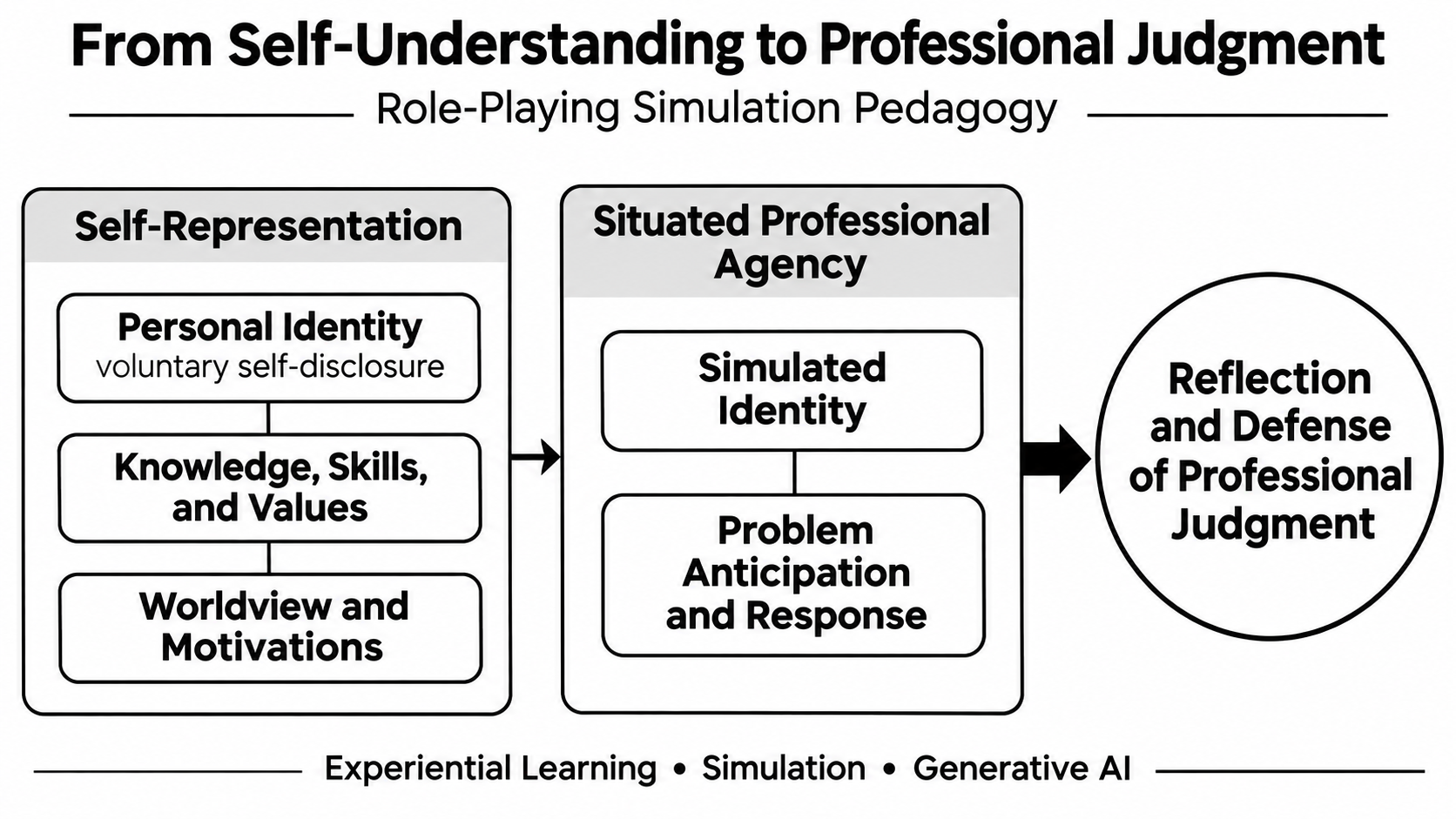
The proposed role-playing simulation pedagogy organizes this transition through five interconnected stages.
The first stage concerns personal identity and voluntary self-disclosure. Students identify aspects of their experiences, interests, relationships, and self-understanding that they are willing to use as the foundation for a simulated professional identity.
This distinction between identity exploration and identity disclosure is essential.
Students should not be required to reveal religious affiliations, cultural heritage, disability status, gender identity, family circumstances, or other sensitive information to demonstrate meaningful self-understanding. Such disclosures may be personally significant, but they are not prerequisites for developing professional judgment.
A student who values financial security, autonomy, collaboration, recognition, or time away from work already possesses a meaningful starting point for reflection.
The pedagogical task is not to determine whether those values are sufficiently sophisticated. It is to investigate how they shape choices.
The second stage concerns knowledge, skills, and value. Students identify what they know, what they can do, and how those capabilities might contribute to another person or organization.
The distinction between personal values and generated value is important.
Personal values are the principles and priorities that influence individual judgment. Generated value concerns the contribution that a person can make through the application of knowledge and skills.
A student may value independence while possessing programming skills that generate value through collaborative software development. Another may value financial security while contributing scientific knowledge to an organization whose decisions require balancing financial sustainability and public responsibility.
These dimensions can complement one another, but they may also produce tensions that deserve examination.
The third stage introduces worldview and motivations. Students examine how they interpret unfamiliar situations, what motivates their choices, and what they consider important when competing priorities emerge.
A student’s motivation might be to earn high grades, graduate successfully, obtain financial independence, support family members, or contribute to society.
The objective is not to classify motivations as inherently superior or inferior. It is to help students recognize how motivations influence their interpretation of situations and their selection of possible responses.
These first three stages establish a foundation for self-representation.
The fourth stage introduces simulated identity.
Students construct a plausible professional character situated within a particular organization or professional context. They select relevant attributes from their earlier reflections while considering the expectations, constraints, and opportunities associated with the simulated environment.
A student does not need to predict accurately who they will become. Instead, the simulation allows them to explore who they might become under particular circumstances.
This distinction becomes especially important when considering organizational culture.
Two computer science graduates with comparable disciplinary preparation may enter organizations with profoundly different expectations concerning collaboration, autonomy, performance, and professional responsibility. Their technical knowledge may remain similar while the contexts influencing their decisions differ.
The simulated identity therefore provides a bridge between personal self-understanding and an imagined professional environment.
The fifth stage introduces problem anticipation and response.
Students encounter a challenge appropriate to their simulated professional identity, propose a course of action, and explain the reasoning underlying their decision.
At this point, identity becomes pedagogically consequential.
The framework moves from self-representation toward situated professional agency.
Artificial Intelligence as a Generator of Situations, Not a Substitute for Judgment
Generative artificial intelligence introduces an opportunity to extend role-playing simulation pedagogy beyond fixed scenarios.
Traditionally, instructors must develop the situations, characters, complications, and decision points that structure educational simulations. This work can be demanding, particularly when students represent different disciplines, levels of preparation, and professional interests.
Generative AI can assist in constructing variable scenarios responsive to students’ simulated professional profiles.
A student might provide a fictionalized profile containing relevant knowledge, skills, values, motivations, and organizational circumstances, then request a plausible professional challenge.
An aspiring computer scientist might encounter a conflict involving data privacy. A future researcher might confront a disagreement about methodological rigor. An engineering student might face competing expectations involving project deadlines, resource limitations, and safety requirements.
However, generating an interesting problem is not the educational outcome.
The critical task begins when students must determine how to respond.
Chien et al. (2025) investigated a role-playing educational game incorporating generative AI scaffolding and interactive feedback. Their findings illustrate how AI-supported interactions can contribute to engaging educational game environments, although the study does not establish that AI-generated simulations independently improve professional judgment.
This distinction matters because the educational value of AI should not be inferred from its ability to produce convincing narratives.
A plausible response is not necessarily a justified response. A technologically sophisticated simulation is not necessarily an educative simulation. An AI-generated explanation is not evidence that the student understands the principles supporting that explanation.
For this reason, I propose treating generative AI as a contextual simulation partner rather than an authority responsible for determining professional decisions.
The AI may generate a dilemma, represent stakeholders, introduce complications, or respond to proposed actions. The student remains responsible for interpreting the situation, developing a solution, examining alternatives, and defending the decision.
The simulation should also be designed so that student choices have meaningful consequences within the represented environment. If the AI merely produces an initial problem followed by a predetermined answer, the experience risks becoming another conventional case exercise rather than a consequential role-playing simulation.
An RPS requires opportunities for participants to influence what happens next.
At the same time, AI-assisted instructional design must preserve student agency and privacy.
UNESCO’s guidance on generative AI in education emphasizes a human-centered approach that protects personal information and preserves meaningful human participation in learning (Fengchun & Holmes, 2023).
Students should therefore be able to use constructed identities rather than transmit sensitive autobiographical information to an AI system. They should also be encouraged to question stereotypes, unsupported assumptions, and potentially misleading information embedded in AI-generated scenarios.
The objective is not to create increasingly convincing artificial professionals. It is to create educational opportunities in which students become more capable of exercising their own professional judgment.
The Pedagogical Importance of Defending a Decision
The most consequential component of the proposed framework may occur after the simulated action.
Imagine that a student identifies fairness as a central personal value, then chooses a solution that benefits one organizational stakeholder at the expense of another.
Rather than evaluating the response only against a predetermined correct answer, the instructor asks why the student selected that action.
How does the decision reflect the student’s stated values? Which knowledge or skills informed the response? Were alternatives considered? What consequences were anticipated? Would the student reconsider the decision after receiving new information?
The purpose is not to demand perfect consistency between personal values and professional behavior.
Professional practice frequently involves competing obligations, incomplete information, and difficult compromises. A decision that appears appropriate from one perspective may generate unexpected consequences when viewed from another.
Instead, the educational objective is to make reasoning visible.
A student may discover that a decision initially justified through efficiency conflicts with an earlier commitment to fairness. Another may recognize that individual autonomy must be negotiated within collaborative work. A third may realize that a technically correct solution produces unintended consequences for the people expected to implement it.
These tensions are not instructional failures.
They are potentially productive opportunities for reflection.
The assessment should therefore examine the relationship between claims, actions, evidence, and consequences. Students should receive recognition for identifying contradictions, revising their reasoning, and explaining why a previously selected solution may no longer be appropriate.
This process also establishes a meaningful distinction between generating an answer and defending professional judgment.
Generative AI may produce a convincing response to a simulated organizational problem. However, when the instructor asks students to explain why that response is appropriate, identify its assumptions, consider competing interests, and defend or revise the underlying reasoning, students must engage with the intellectual responsibilities associated with the decision.
The educational objective is not to prohibit AI assistance. It is to ensure that AI assistance does not replace the student’s responsibility for judgment.
In this sense, role-playing simulation pedagogy creates a bridge between reflective self-understanding and accountable professional action.
It also changes the instructor’s role.
The instructor is no longer limited to evaluating whether a student produced an acceptable answer. The instructor becomes a facilitator who introduces uncertainty, challenges assumptions, and encourages students to articulate the principles informing their decisions.
Toward an Interdisciplinary Pedagogy of Simulated Professional Judgment
One reason I find this proposal compelling is its potential applicability across disciplines.
Professional identity is not produced exclusively through disciplinary training. It emerges through interactions among disciplinary knowledge, institutional expectations, organizational culture, personal motivations, and relationships with other people.
Two graduates with equivalent academic preparation may encounter profoundly different professional environments. Their technical knowledge may remain similar, while the conditions governing collaboration, responsibility, authority, and decision-making differ substantially.
A role-playing simulation can make these contextual differences available for examination before students enter the workforce.
The framework may also support interdisciplinary learning.
Students from different majors could examine the same organizational problem while approaching it through different knowledge bases, professional priorities, and interpretive assumptions.
For example, a fictional technology organization might encounter a conflict involving product accessibility, financial sustainability, and data privacy.
Computer science, engineering, business, and communication students could develop different responses grounded in their respective disciplinary competencies.
The instructional contribution would not lie in requiring every student to arrive at the same conclusion. It would lie in creating opportunities for students to understand how different disciplinary perspectives contribute to a problem, where those perspectives conflict, and how defensible decisions might emerge through negotiation.
These interactions also suggest opportunities to study communication across disciplinary boundaries.
When students must explain technical knowledge to participants representing different professional perspectives, they engage in processes of translation, interpretation, negotiation, and justification.
A simulated organizational disagreement can therefore become an opportunity to examine not only what students know but also how they communicate that knowledge, recognize competing expertise, and negotiate collective decisions.
This possibility aligns with broader interests in interdisciplinary and transdisciplinary communication.
However, the existence of a shared simulation does not automatically establish interdisciplinary integration or transdisciplinary collaboration. These outcomes would need to be designed explicitly and examined empirically.
Similarly, collaboration should not be assumed merely because several students participate in the same fictional environment. Meaningful collaboration requires interdependent tasks, opportunities for negotiation, and conditions in which participants can influence one another’s decisions.
A well-designed RPS could create these conditions, but its effectiveness would depend on the relationship between scenario architecture, participant agency, instructional facilitation, and reflective assessment.
The Need for a Pedagogy That Moves Beyond Identification
Higher education cannot provide students with advance experience of every organizational environment, professional conflict, or ethical dilemma they will encounter.
Nor should it attempt to prescribe a single correct professional identity.
What it can provide is a structured environment in which students examine how their existing knowledge and values influence action under conditions of uncertainty.
This is the central promise I see in role-playing simulation pedagogy.
The proposed progression begins with voluntary self-representation, develops through knowledge, skills, values, worldview, and motivations, and culminates in the construction of a simulated professional identity.
Students then encounter problems, act within contextual constraints, and defend their decisions through reflection and discussion.
This process could be organized through successive iterations rather than a single assignment.
An initial exercise might require students to identify their knowledge, skills, and motivations. A second might introduce a simulated professional environment. A third might present a dilemma generated through AI assistance. Subsequent activities could introduce new information, competing stakeholder priorities, or consequences that challenge the student’s original assumptions.
Each iteration would create an opportunity to reconsider earlier decisions.
This recursive structure connects RPS to experiential learning and reflective practice while preserving its distinctive emphasis on role construction, situated agency, and consequential response.
It also creates opportunities for instructional assessment.
Rather than evaluating students primarily on their willingness to disclose personal information, instructors could examine the coherence of their reasoning, their application of disciplinary knowledge, their ability to recognize conflicting values, and their capacity to justify or revise decisions.
The instructional emphasis would move from the content of personal identity toward the observable quality of professional judgment.
Nevertheless, the proposed framework remains a pedagogical model under development.
Its anticipated benefits for professional identity, reflective reasoning, and decision-making require systematic classroom implementation and evaluation.
An initial pilot could investigate how students articulate values before simulation, how they apply those values during decision-making, how they respond to contradictions, and whether successive iterations produce more sophisticated explanations of professional consequences.
Such an evaluation would also need to consider instructional workload, accessibility, student perceptions, AI-generated biases, and the extent to which learners meaningfully retain responsibility for their decisions.
The goal is not to assume that role-playing simulation is inherently superior to other instructional strategies. It is to determine under what conditions RPS offers educational opportunities that conventional identity exercises, case studies, or reflective assignments may not provide independently.
Closing Reflection: From Self-Discovery to Professional Judgment
The question that motivates this work is deceptively simple: What happens after students tell us who they are?
Educational activities often treat the identification of knowledge, abilities, motivations, and personal values as important evidence of self-understanding.
I believe we need to ask the next question.
What will students do with what they know about themselves when the world presents them with a problem they did not anticipate?
Role-playing simulation offers a structured way to explore that question, not by predicting the future, but by allowing students to practice making, explaining, and reconsidering decisions before those decisions carry the consequences of professional practice.
The educational value is not in discovering a fixed identity. It is in developing the capacity to act reflectively within an evolving one.
A student who can identify a value has completed an important reflective exercise. A student who can explain how that value influences a difficult decision has begun to develop something more consequential.
A student who can reconsider and defend that decision after encountering uncertainty, disagreement, or unexpected consequences has begun practicing the reflective responsibilities associated with professional life.
This is the educational transition worth investigating.
Our next challenge is to determine whether role-playing simulation pedagogy, supported by carefully designed generative AI interactions, can make this transition more explicit, teachable, and assessable across undergraduate disciplines.
The future of experiential learning in higher education should not be limited to providing students with more experiences. It should involve designing experiences that make the relationship between knowledge, identity, judgment, and action visible.
Ultimately, the purpose of RPS is not to tell students who they should become.
It is to help them understand how their decisions participate in the ongoing construction of who they are becoming.
APA Citation
León, C. (2026, November 13). From Self-Understanding to Professional Judgment: Why Higher Education Needs Role-Playing Simulation Pedagogy [Com]. Cristo León. https://www.cristoleon.com/2026/11/13/role-playing-simulation-pedagogy-higher-education/
References
Chien, C.-C., Chan, H.-Y., & Hou, H.-T. (2025). Learning by Playing with Generative AI: Design and Evaluation of a Role-Playing Educational Game with Generative AI as Scaffolding for Instant Feedback Interaction. Journal of Research on Technology in Education, 57(4), 894–913. https://doi.org/10.1080/15391523.2024.2338085
Dewey, J. (2007). Experience And Education. Simon and Schuster. (Original work published 1938, Kappa Delta Pi / The Macmillan Company)
Fengchun, M., & Holmes, W. (2023). Guidance for Generative AI in Education and Research [PDF]. UNESCO. https://unesdoc.unesco.org/ark:/48223/pf0000386693
Kolb, D. A. (1983). Experiential Learning: Experience as the Source of Learning and Development (First Edition) (1st edition). Prentice Hall.
Schön, D. A. (2016). The Reflective Practitioner: How Professionals Think in Action. Routledge.
Squires, K., Judd, B., Ryall, T., van Diggele, C., Britt, K., & Irwin, P. (2025). The impact of interprofessional simulation-based experiences in fostering the development of health professional students’ professional identity: A scoping review. Nurse Education Today, 153, 106828. https://doi.org/10.1016/j.nedt.2025.106828