
By Cristo Leon, Ph.D.
Last reviewed: November 29, 2026.
I recently had a conversation with a younger professional who is considering pursuing a Ph.D. while working. The discussion stayed with me because it surfaced a question I hear often:
How do I know which Ph.D. program I should apply to?
My answer is increasingly simple:
Do not start with the program. Start with the problem.
For someone who is already working, has accumulated professional experience, and is thinking seriously about doctoral education, the decision is different from that of a traditional student moving directly from undergraduate study to a master’s degree and then into a Ph.D.
If you are considering a Ph.D. while working, you are not necessarily beginning a research career.
You may already be in one.
A Ph.D. While Working Is Not the Same as Starting From Zero
The traditional academic pathway is familiar:
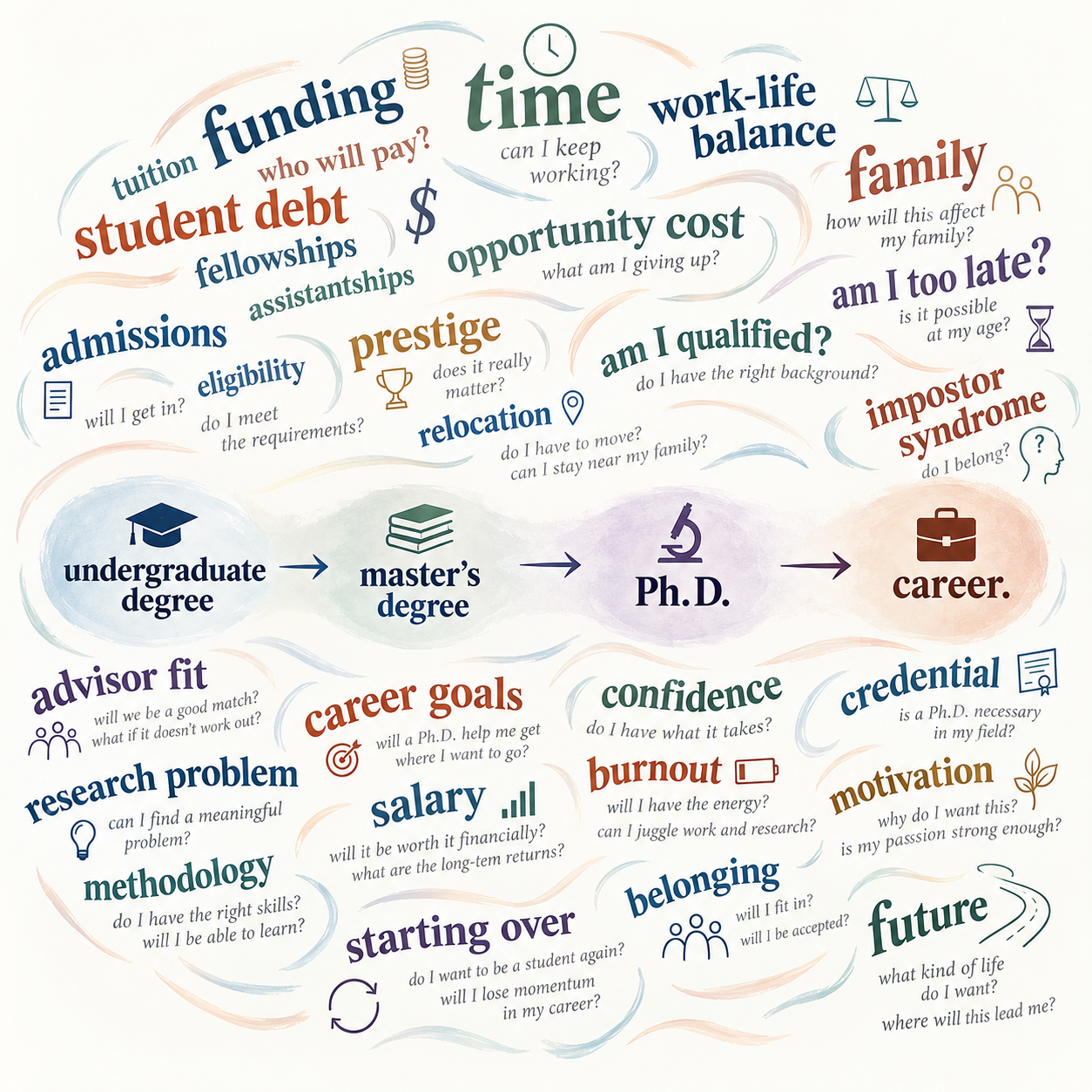
undergraduate degree → master’s degree → Ph.D. → career.
There is nothing wrong with that path.
But it is not the only path.
Many professionals complete their undergraduate education, enter the workforce, develop expertise, participate in research, contribute to externally funded projects, manage programs, teach, publish, collaborate with faculty, or develop specialized knowledge before returning to doctoral education.
That professional experience matters.
If you already understand how organizations function, how research projects operate, how grants are managed, how teams collaborate, or how real-world problems differ from textbook problems, you are not entering doctoral education with nothing.
You are entering with context.
And context can produce better research questions.
That is why I would not frame a working professional as someone who is simply going back to school.
I would frame them as an experienced practitioner or researcher entering advanced scholarly formation.
That distinction matters.
The Credential Matters, but It Cannot Be the Entire Reason
Sometimes the motivation for pursuing a Ph.D. while working is straightforward:
I am already doing advanced work, but I do not have the credential.
That is not an illegitimate concern.
Credentials matter.
There are professional environments in which the absence of a doctorate can eventually limit advancement, eligibility, authority, mobility, or access to particular opportunities.
Someone may already have substantial expertise and still encounter a point where the lack of a doctoral degree becomes the barrier.
But I do not think “I need the paper” is sufficient, by itself, to justify several years of doctoral study.
The stronger question is:
What do I need to become capable of doing that I cannot yet do?
That is where the doctorate becomes intellectually meaningful.
The Ph.D. should not simply certify that you are intelligent or capable.
It should develop something you do not yet possess.
Perhaps that is deeper theoretical knowledge.
Perhaps it is methodological sophistication.
Perhaps it is sustained mentorship.
Perhaps it is access to a particular research community.
Perhaps it is the ability to turn years of professional experience into a coherent and original scholarly contribution.
That is the gap that matters.
Your Professional Experience Should Become Part of the Dissertation
One of the biggest mistakes I see working professionals make is treating their career history almost apologetically.
They say:
“I worked for ten years before deciding to go back for a Ph.D.”
I would tell that story differently.
I would say:
My professional experience exposed me to increasingly complex problems, and I have reached the point where investigating those problems requires deeper theoretical and methodological development.
That is a much stronger narrative.
Your work experience should not disappear when you enter a doctoral program.
Ideally, it should help define the research problem.
The best Ph.D. for a working professional is often not one that asks them to abandon everything they already know.
It is one that helps them transform experience into inquiry.
Start With the Research Problem, Not the University Ranking
When people begin exploring doctoral education, they often start with university names.
They search for:
“best Ph.D. programs”
“top universities”
“best STEM education Ph.D.”
“best mathematics education programs”
I understand why.
But I think this approach is backwards.
The first question should be:
What problem do I want to become capable of studying?
That question forces you to think beyond institutional reputation.
A prestigious university may have an excellent doctoral program and still be a poor intellectual fit for your research trajectory.
A less obvious institution may have exactly the faculty member, methodology, laboratory, research center, or intellectual community that you need.
Doctoral fit is not simply about whether a university is good.
It is about whether the institution places you close to the intellectual conversation you want to enter.
I Think of Doctoral Programs as Ports
I often use a travel analogy when discussing doctoral program selection.
Imagine that your goal is to travel to Spain.
You could begin the journey from California.
You could also begin from New York.
Both routes can eventually get you there.
But they are not equally positioned.
A doctoral program works in a similar way.
Many universities may technically allow you to study a topic.
But some place you much closer to the theories, methods, scholars, and research communities you will ultimately need.
That is why I would not ask only:
Can I study this here?
I would also ask:
How much intellectual distance will I have to travel from this program to become the scholar I want to become?
Choosing a Ph.D. is partly about choosing the right port.
Read Recent Papers Until Something Makes You Stop
One of the most practical ways to identify a doctoral research direction is to read.
But I would read strategically.
Start with recent papers in the area you think interests you.
Do not initially try to become an expert in everything.
Pay attention to your reaction.
Some papers will make you think:
“That is interesting.”
Others will make you think:
“That is a good conclusion.”
Those papers may be useful.
But the papers I pay the most attention to are the ones that make me stop and ask:
Wait. Why are they even studying this?
That moment matters.
Sometimes you encounter a research problem you did not even know existed.
You may not fully understand the question.
You may not understand the method.
You may not even understand why the problem matters yet.
That confusion can be productive.
Follow it.
Read the references.
Look at the authors.
Look at their research groups.
Look at where they work.
Look at who they collaborate with.
Eventually, patterns appear.
You may discover that the research questions that truly fascinate you are being investigated by only a few scholars or institutions.
That is when your Ph.D. search becomes much more focused.
You are no longer looking for a good university.
You are looking for the people who are already participating in the intellectual conversation you want to join.
Do Not Build a Ph.D. Around the Current Fashion
This is especially important in fast-changing fields such as STEM education.
Educational research moves through waves.
Problem-based learning.
Experiential learning.
Personalized learning.
Learning analytics.
Artificial intelligence.
Competency-based education.
Each of these areas can produce important research.
The problem begins when one approach becomes so dominant that everyone starts treating it as the solution to every educational problem.
When every problem looks like a nail, everyone starts carrying the same hammer.
A Ph.D. can take several years.
By the time you graduate, today’s fashionable topic may already be mature, saturated, or being challenged by the next intellectual movement.
That does not mean you should avoid emerging topics.
It means you should ask a more difficult question:
What problem will still matter after the current enthusiasm disappears?
That question is much more useful for building a sustainable research career.
Think Five Years Beyond the Ph.D.
When evaluating doctoral programs, I would not choose only based on what interests you today.
I would ask what your field may need five or ten years from now.
That requires some speculation.
It also requires intellectual courage.
For example, I am increasingly interested in what education must accomplish as machine intelligence becomes more capable and more widely available.
If access to advanced intelligence becomes increasingly common, education may eventually need to place greater value on capabilities that are difficult to outsource:
collaboration,
judgment,
negotiation,
communication,
creativity,
empathy,
strategic thinking,
and the ability to work effectively across disciplinary and cultural boundaries.
That leads to a different research question.
Instead of asking only:
“How do we use AI in education?”
we might ask:
What must humans become better at when access to intelligence itself becomes increasingly abundant?
That question may lead to very different doctoral work.
It may lead toward experiential learning, collaboration, role-playing, simulation, human-machine teams, or new models of STEM education.
The important point is not that this particular prediction will be correct.
The point is that doctoral students should be thinking beyond today’s dominant conversation.
Ph.D. Funding Should Be Part of the Decision
If you are pursuing a Ph.D. while working, there is also an economic reality that should not be ignored.
Doctoral education has both direct costs and opportunity costs.
Tuition is only part of the calculation.
There is also time.
There is energy.
There are evenings and weekends.
There may be promotions you delay, projects you decline, income you temporarily reduce, or family time you sacrifice.
That is why I would seriously investigate funded Ph.D. programs, graduate assistantships, research assistantships, fellowships, employer tuition benefits, and other forms of institutional support before taking on substantial student debt.
I do not believe free automatically means best.
But I do believe that significant debt for a research doctorate should require a very strong justification when funded alternatives exist.
For a working professional, the financial question should not simply be:
Can I afford the tuition?
It should be:
Does the intellectual and professional value of this program justify the total cost of completing it?
Those are very different questions.
The Ph.D. Should Close a Capability Gap
For me, the most important part of the conversation comes down to two statements.
If you are considering a Ph.D. while working, try completing these:
Through my professional experience, I have become increasingly interested in __________.
Then:
The problem I now want to investigate requires deeper expertise in __________.
The first statement identifies your research trajectory.
The second identifies your capability gap.
That capability gap is what the Ph.D. should address.
Maybe you need stronger quantitative methods.
Maybe you need ethnography.
Maybe you need learning sciences.
Maybe you need psychology.
Maybe you need advanced mathematics.
Maybe you need organizational theory.
Maybe you need design-based research.
Maybe you need access to laboratories, archives, communities, or technologies that you cannot currently reach.
Once you know what you are missing, you can evaluate doctoral programs much more intelligently.
My Recommended Sequence
If I were advising someone under 35 who is already working and thinking about starting a Ph.D., I would recommend the following sequence:
First, identify the problem.
What have you encountered professionally that you cannot stop thinking about?
Second, identify your capability gap.
What do you need to learn in order to study that problem rigorously?
Third, identify the scholars.
Who is already working on questions adjacent to yours?
Fourth, identify the programs.
Where are those scholars, laboratories, research groups, or intellectual communities located?
Fifth, evaluate the economics.
What funding is available? What would you need to give up? Can you remain employed? Does the institution support working professionals?
Finally, consider prestige and geography.
Those things matter.
But they should not come first.
You Are Not Starting Over
This may be the most important point.
If you are already working and considering a Ph.D., you are not necessarily starting a new life.
You are not erasing your professional identity and becoming just a student.
At least, you should not be.
You are bringing years of accumulated experience into a more advanced stage of scholarly development.
Your professional experience may already have shown you problems that younger students have not yet encountered.
Your practice may have exposed contradictions that theory does not fully explain.
Your work may have placed you in communities that academic researchers struggle to access.
Those experiences are not distractions from doctoral research.
They may be the reason your research matters.
The goal of the Ph.D. should therefore not be to start over.
It should be to transform professional experience into a rigorous research agenda.
So before asking:
Which Ph.D. program should I apply to?
I would ask something more difficult:
What have I encountered through my work that I now understand well enough to recognize as a problem, but not yet well enough to explain?
That is where I would begin.
Not with the university.
Not with the ranking.
Not even with the degree.
With the problem.